


Crypto News FeedCryptoBuzz: What It Is and How to Use It Safely
Searching for crypto news FeedCryptoBuzz usually leads to a cryptocurrency and technology content website. Its public pages cover subjects such as Bitcoin, Ethereum, blockchain, decentralized finance, Web3, market movements, regulation, exchanges, and new projects. It should be understood as a publishing source—not automatically as a trading platform, wallet, token, financial adviser, or regulated investment service.
That distinction matters. A news article can introduce a useful topic, but it cannot execute a trade, protect your private keys, guarantee a price forecast, or replace primary evidence. The best way to use FeedCryptoBuzz is as one input in a broader research process: read the story, identify its underlying claim, open the original source, check the date and jurisdiction, and decide whether the evidence supports the headline.
Key Takeaways
- FeedCryptoBuzz is best classified as a crypto and technology content website.
- Reading a story does not create an account, buy crypto, or provide custody of assets.
- A publication’s own description is not independent proof of its accuracy or influence.
- Market prices and breaking-news details require a visible timestamp and a second reliable source.
- Project claims should be checked against official documentation, code repositories, and blockchain data where relevant.
- Regulatory and tax claims must name the authority, jurisdiction, and effective date.
- Never connect a wallet, reveal a seed phrase, or send funds merely because a link appears in a news article.
What FeedCryptoBuzz Appears to Publish
The accessible FeedCryptoBuzz pages present a mix of cryptocurrency and broader technology material. Crypto topics include major assets, blockchain systems, decentralized finance, Web3 developments, regulation, exchanges, market trends, and emerging projects. Some pages use terms such as “real-time insights,” “trend projections,” or “market details.” Readers should treat these as descriptions of the publication’s intended coverage unless a page clearly explains the data source, update interval, analytical method, and limitations.
FeedCryptoBuzz does not appear to be limited to a single type of article. A reader may encounter news summaries, general explainers, opinion, forecasts, or promotional-looking project coverage. Those formats demand different levels of evidence. A report about an official filing can be checked against the filing. A market forecast interprets uncertain conditions. A sponsored project announcement may primarily represent the project team’s view.
The name can also create confusion because similar domains and pages use close variations of “FeedCryptoBuzz.” Confirm the full domain before relying on a page. A matching name, logo, or article title does not prove that two sites have the same owner or editorial standards.
What Crypto News FeedCryptoBuzz Is Not
No news publication should be mistaken for the financial service mentioned in its articles. Based on its public-facing content, FeedCryptoBuzz should not be assumed to provide any of the following:
- a customer cryptocurrency exchange account;
- custody of coins or private keys;
- an on-chain wallet;
- guaranteed live market data;
- personalized investment advice;
- audited token ratings;
- regulatory approval for projects it discusses;
- guaranteed returns or accurate forecasts.
If a FeedCryptoBuzz page links to an outside trading platform or token sale, that destination is a separate service with its own operator, terms, fees, custody model, and risks. Research it independently. Pointed Editorial’s Qaventro review highlights the operator, app, regulatory, and withdrawal questions to ask before depositing with an unfamiliar platform.
Is FeedCryptoBuzz Reliable?
There is no honest one-word answer. Reliability depends on the individual claim, not just the website name. A publication can accurately summarize one official announcement and publish a weakly supported forecast on the same day. Evaluate the author, sources, method, date, disclosures, corrections, and scope of each article.
Start with transparency. Does the page identify an author? Does it distinguish reported facts from opinion? Does it link to the source behind a statistic, quotation, regulatory change, security incident, or company announcement? Does it include a publication date and, for a changing story, an update time? Does the site explain sponsored or affiliate relationships?
Then test the evidence. A statement such as “Company X announced a product” is supported by a dated company release, although the release still represents the company’s account. A statement that a protocol has a certain amount of locked value should link to reproducible data and specify the measurement time. A claim that a token will rise is not established by optimistic language, past price movement, or social-media attention.
Self-description also has limits. A site calling itself accurate, trusted, expert-led, or influential does not prove those qualities on its own. Strong reporting shows its work and makes uncertainty visible.
A Practical Method for Checking Any Crypto Story
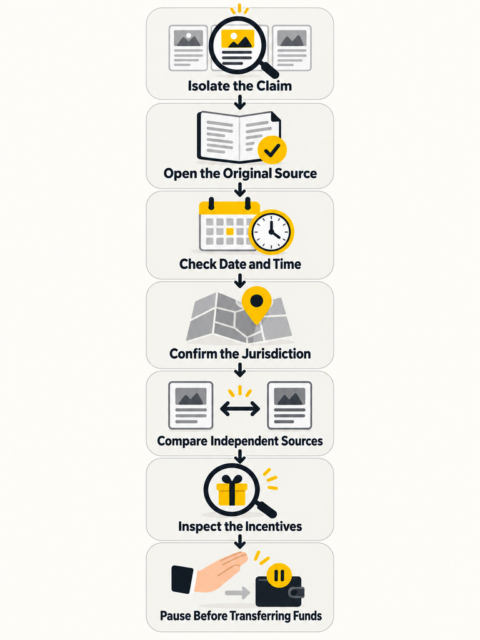
Use the following process before a headline affects a trade, transfer, or long-term decision.
1. Reduce the Article to One Testable Claim
Separate the core event from the commentary surrounding it. For example: “A regulator filed an enforcement action on this date,” “an exchange added withdrawals for this asset,” or “a protocol disclosed an exploit affecting a stated contract.” Precise claims are easier to verify than broad narratives such as “mass adoption has arrived.”
2. Open the Primary Source
Look for the original court filing, regulator notice, company statement, protocol incident report, governance proposal, blockchain transaction, or technical documentation. A screenshot of a post is weaker than the original account and can omit edits or context.
For U.S. investor alerts, start with Investor.gov’s crypto resources. You can also check fraud warnings through the Federal Trade Commission, while derivatives-related claims may require the Commodity Futures Trading Commission.
3. Check the Date, Time, and Market Context
Crypto trades continuously, so “current” figures can quickly become stale. A useful market statement identifies the asset, trading pair, venue or data provider, timestamp, and period being compared. A price move on one thinly traded venue may not represent the broader market.
Watch for old stories recirculating as new. Confirm both the publication date and the date of the underlying event. An updated page should explain what changed rather than silently presenting an old development as breaking news.
4. Check the Jurisdiction
“Crypto is legal,” “this exchange is regulated,” or “profits are tax-free” are incomplete statements unless they identify a jurisdiction and the relevant activity. Rules can differ for issuance, trading, custody, staking, promotion, payments, derivatives, and taxation. An authorization in one country does not automatically apply elsewhere.
For global comparisons, the Financial Stability Board’s crypto framework explains high-level regulatory recommendations, but readers still need the applicable national or state authority for a personal decision.
5. Look for Independent Confirmation
Find a second reputable source that reached the claim independently. Two articles repeating the same press release are not two separate confirmations. Trace both back to their evidence.
6. Identify the Incentive
Ask who benefits if you believe or share the story. Relevant disclosures may include sponsorship, token ownership, affiliate links, paid placements, exchange relationships, referral bonuses, or participation in a project. A conflict does not automatically make a claim false, but hiding it weakens trust.
7. Delay Irreversible Action
Crypto transfers may be difficult or impossible to reverse. Urgency is therefore a reason to slow down. Confirm the address through an official channel, test with a small amount when appropriate, verify the network, and never act solely because of fear of missing out.
How to Evaluate Different Types of FeedCryptoBuzz Stories
Not every crypto article should be checked in the same way. Use the evidence that fits the claim.
| Story type | Best evidence | Main warning |
|---|---|---|
| Price or volume | Timestamped data from multiple established market sources | A single venue, illiquid pair, or stale snapshot may mislead |
| Exchange listing | Official exchange announcement and live market page | Fake listing posts and look-alike domains are common |
| Regulation | Regulator, legislature, court, or official gazette | A proposal, filing, and final rule are not the same |
| Project launch | Official documentation, named team, code, contracts, and independent review | A roadmap describes intentions, not completed work |
| Security incident | Protocol disclosure, security researchers, on-chain evidence, and post-mortem | Early loss estimates and causes often change |
| Market forecast | Transparent assumptions, method, scenario range, and stated invalidation conditions | A confident target is still uncertain |
| Sponsored content | Clear disclosure plus independent verification of every material claim | Paid visibility is not due diligence |
The table is a starting point, not a scorecard that can certify truth. Some stories need specialist analysis. Smart-contract exploits, reserve attestations, legal actions, and token economics may require technical or professional interpretation beyond a general news summary.
Red Flags in Crypto News and Promotional Coverage
A polished page can still contain weak evidence. Slow down when an article or linked destination uses any of these patterns:
- guaranteed returns or claims that an investment has no risk;
- a countdown, limited allocation, or pressure to deposit immediately;
- anonymous experts presented without verifiable sources;
- price targets with no method, assumptions, or downside case;
- claims of regulation that do not name the authority or license;
- testimonials used as proof of performance;
- instructions to send crypto to unlock funds or withdrawals;
- requests for a seed phrase, private key, remote access, or unusual wallet signature;
- a token contract address shared only through a comment or direct message;
- copied articles that all trace back to one promotional release.
The FTC warns that scammers often combine cryptocurrency with impersonation, investment promises, or payment demands. A useful rule is simple: news can inform your next research step, but it should not bypass your security checks.
Readers investigating a named person or investment narrative can also see Pointed Editorial’s examination of Abraham Quiros Villalba crypto claims. It demonstrates why a first-person biography or website claim should be separated from independent verification. The guide to PedroVazPaulo crypto investment applies the same principle to a named investment concept.

How FeedCryptoBuzz Can Still Be Useful
Used carefully, a broad crypto publication can help readers discover topics they would not otherwise encounter. It can surface new terminology, point to a regulatory development, summarize a project announcement, or help build a list of questions for further research.
The safest use cases are exploratory. Read a FeedCryptoBuzz article to understand the outline of a topic, locate names and documents, and compare competing interpretations. Then move from commentary to evidence.
It can also help readers monitor themes across the industry—custody, stablecoins, exchange risk, institutional activity, tokenization, network upgrades, or security incidents—without treating every headline as equally important. A personalized feed should reduce noise, not encourage constant reaction.
For comparisons involving actual trading services, use product documentation and current fee schedules alongside editorial coverage. Pointed Editorial’s guide to Coinbase alternatives shows how trading access, custody, available assets, fees, and user needs can differ across platforms.
Build a Better Crypto News Routine
Constant alerts can make ordinary volatility feel urgent. A simple routine is more useful than refreshing headlines all day.
A Low-Noise Research Routine
- Scan: Review headlines at set times and save only stories connected to your research plan.
- Classify: Mark each item as reported event, analysis, opinion, forecast, or promotion.
- Verify: Open the primary source and one independent confirmation.
- Record: Note the date, source, claim, evidence, uncertainty, and what would disprove it.
- Decide later: Separate reading time from trading or transfer decisions whenever possible.
This routine makes it easier to spot a story with little substance. It also creates a record of what you knew at the time, rather than allowing a later price move to rewrite your memory of the evidence.

Conclusion
Crypto news FeedCryptoBuzz is best understood as cryptocurrency and technology editorial content. It may help readers discover market topics, project announcements, regulatory developments, and educational material, but it is not an exchange, wallet, regulator, or independent guarantee that every claim is accurate.
Use it as a starting point. Check the original evidence, date, jurisdiction, author, disclosures, and independent confirmation. Treat predictions as uncertain, separate sponsored material from reporting, and never let a headline override basic wallet or payment security. In crypto, the quality of your verification process matters more than the headline’s confidence.
Frequently Asked Questions
What is crypto news FeedCryptoBuzz?
It refers to cryptocurrency news, explainers, and market-related content published under the FeedCryptoBuzz name. The public website functions as an information source rather than a cryptocurrency exchange or wallet.
Is FeedCryptoBuzz a crypto exchange?
No exchange functionality was evident on the public content pages reviewed. Do not assume an article website can hold funds, execute trades, or provide regulated custody. Research any linked trading service as a separate company.
Is FeedCryptoBuzz reliable for investment decisions?
Do not base an investment decision on one publication. Evaluate each article’s author, date, sources, disclosures, and method, then confirm material claims through primary and independent sources.
Does FeedCryptoBuzz provide real-time crypto prices?
A page may discuss current prices or market movements, but “real time” should not be assumed without a named data provider, visible timestamp, refresh method, and clear trading pair. Confirm prices on established market-data sources and the venue you intend to use.
Can I buy cryptocurrency through FeedCryptoBuzz?
Reading the publication is not the same as opening an exchange account. If an article links to a third-party service, that service has its own operator, terms, fees, and risks. Verify it independently before creating an account or sending funds.
How do I know whether a crypto article is sponsored?
Look for labels such as sponsored, partner, advertorial, press release, or affiliate disclosure. Also inspect unusually promotional wording and calls to buy. If the commercial relationship is unclear, treat the content cautiously and verify all material claims elsewhere.
What should I do if a link asks me to connect my wallet?
Stop and verify the destination through the project’s official channels. Check the full domain and requested permissions. Never enter a seed phrase or private key, and do not approve a transaction you do not fully understand.
How quickly does crypto news become outdated?
Prices and breaking events can change within minutes, while regulations, product availability, and project documentation may change over longer periods. Always check the article date, the date of the underlying event, and the latest primary source.