


Trippin’ Ape Tribe Crypto: What Is It and Is It Worth Buying?
Trippin’ Ape Tribe crypto is a search phrase people use for a Solana NFT collection. It does not, by itself, identify a cryptocurrency coin. Each Trippin’ Ape Tribe NFT is an individual digital collectible that may have its own traits, owner, listing price, and sales history.
That difference is essential if you are thinking about buying one. A collection’s displayed floor price is not a guaranteed resale value. Its popularity during the 2022 NFT market is historical context, not proof of current demand. And a token or website with a similar name is not automatically connected to the original collection.
This guide explains what the project is, why it became known, how to read its marketplace data, which holder features can be checked, and what to verify before approving a wallet transaction.
What to know before buying
- Trippin’ Ape Tribe is a collection of individual NFTs on Solana, rather than interchangeable units of one coin.
- The project describes a 10,000-ape collection, while a market-data provider may report a different number of minted NFTs. Check which measure a figure represents.
- A floor price is the lowest displayed asking price. Completed sales provide different information about demand.
- Claims about future utility should be separated from holder features that are available and documented now.
- Verify the collection, individual item, website address, and wallet request before approving a purchase.
What is Trippin’ Ape Tribe?
Trippin’ Ape Tribe describes itself as a Solana PFP project. PFP stands for profile picture: the artwork can be used as a digital identity, although an owner may collect it. The project combines ape characters with a fictional story, community branding, and proposed holder experiences. Its project description is useful for understanding what its creators say they are building; promotional descriptions should still be distinguished from independently verified results.
An NFT is an identifiable digital asset recorded on a blockchain. Unlike units of SOL, two NFTs in the same collection are not necessarily interchangeable. One ape may display different traits from another. They can also have different listings and transaction histories.
Buying an NFT does not mean you own part of the company or project behind it. Nor does it automatically entitle you to revenue, royalties, or a future payment. To understand what a purchase includes, examine the applicable terms and any currently available holder features.
Where does Solana fit in?
Solana is the blockchain on which the collection exists. It is also the name commonly used for the network’s native cryptocurrency, SOL. The network supports many applications, including digital art, as explained in Solana’s overview of its uses.
You may encounter prices quoted in SOL when viewing Solana NFTs. That does not make the NFT and SOL the same asset:
- SOL is a cryptocurrency. Units of SOL are interchangeable.
- A Trippin’ Ape Tribe NFT is a specific collectible.
- A SOL price beside an NFT is what a seller asks, or what a buyer previously paid, for that particular item.
If SOL’s dollar value changes while an NFT remains listed for the same amount of SOL, its displayed dollar equivalent can change too. A buyer therefore needs to understand both the NFT’s asking price and the currency used to pay it.
Is there a Trippin’ Ape Tribe token?
The collection should not be mistaken for a separately verified coin merely because a price tracker displays an abbreviation. On its Trippin’ Ape Tribe NFT page, CoinGecko labels the collection “TAT.” That label appears in the context of NFT collection data.
A fungible token advertised as “TAT,” “Tribe,” or another similar name would need its own evidence of authenticity. Its name, logo, or image cannot establish that the Trippin’ Ape Tribe team created or endorsed it. A token’s mint address identifies a particular Solana token; a name can be copied.
Before considering any separately advertised token, look for a direct statement from the relevant project, the precise mint address, and independent evidence that the statement and token match. If that evidence is unavailable, leave the relationship unverified. Pointed Editorial’s guide to checking the identity of a Solana crypto asset illustrates why names alone are insufficient, although its token-swap steps do not apply to purchasing an NFT.

Why did Trippin’ Ape Tribe become popular?
The collection gained attention in 2022, when Solana profile-picture NFTs were attracting substantial trading interest. CoinGecko included Trippin’ Ape Tribe among the notable Solana NFT collections in its second-quarter 2022 research report. Reporting from that period also associated its launch with a surge in Solana NFT trading.
The project’s presentation helped distinguish it from a simple set of ape images. Its website tells a fictional story involving a character called Chorles and emphasizes a shared community identity. These elements explain part of the collection’s appeal. They do not establish that the project will maintain buyer interest or deliver a financial return.
It is especially easy to misuse a historical price here. A 2022 article may describe a high floor price during the launch period. That number is useful for describing what happened then. It is not a quote for a current purchase, a valuation of someone’s NFT today, or evidence that the earlier price will return.
How large is the collection?
The project website describes 10,000 apes. When checked for this article, CoinGecko’s collection page displayed 9,360 minted NFTs. These statements concern different measures: the project’s stated collection concept and a data provider’s reported minted count. www.trippinapes.com
Avoid combining them into a claim such as “exactly 10,000 NFTs are currently circulating.” If supply or rarity matters to your decision, review the current collection data and understand what its provider counts. Holder totals also measure wallet addresses, which are not necessarily the same thing as individual people.
How is a Trippin’ Ape Tribe NFT priced?
An owner can list an individual NFT for a chosen amount. A displayed collection price usually points to the cheapest available listing, known as the floor. The seller may change that ask, remove the listing, or sell the item. Another owner may list a visually different ape for much more.The lowest displayed asking price for an NFT in a collection on a specified source at a specified time. An ask is not a completed sale and does not guarantee what another NFT could sell for.
A floor price is useful, but it answers only one narrow question: What is the least expensive available listing displayed here right now? It does not answer whether buyers are active, whether that listing is comparable to the NFT you own, or whether its seller will receive the requested amount.
For example, imagine three owners asking 0.10, 0.12, and 0.30 SOL. The floor is 0.10 SOL. If no one buys any of them, those asking prices provide little evidence of a price at which an owner can promptly sell. This example is illustrative; it is not a current quote for Trippin’ Ape Tribe.
Four figures that tell different stories
Read more than the floor price
| Measure | What it tells you | What it cannot prove |
|---|---|---|
| Floor price | Lowest displayed seller ask at a point in time | That your NFT will sell for the same amount |
| Completed sale | Price paid for a specific NFT in a recorded transaction | That another item can achieve that price now |
| Trading volume | Value of transactions recorded during a stated period | That every item in the collection has an active buyer |
| Holder count | Number of addresses reported as holding collection NFTs | Number of distinct human owners or future buyers |
A market page may also show an estimated collection market capitalization. That is a calculation, not money held in an account and not a promise that every owner could sell at the price used in the calculation.
When reviewing CoinGecko’s NFT market data, read update times carefully. Some marketplace entries on the page were marked as last updated more than a year earlier when reviewed for this article. Such entries are poor evidence for a transaction you plan to make now. www.coingecko.com
Can a rare ape sell for more?
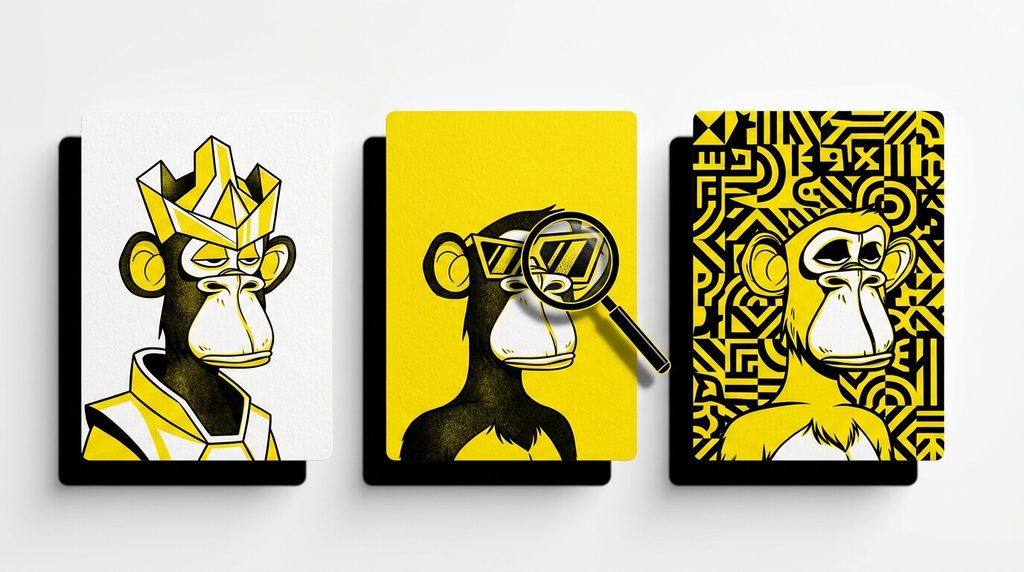
It can, if buyers value its particular appearance or traits. Rarity, however, does not force anyone to pay a premium. A rare feature might be desirable to one collector and unappealing to another.
In its explanation of statistical NFT rarity, Magic Eden describes ranking traits by their frequency in a collection. That gives a way to compare how uncommon traits are. It is not a guaranteed appraisal of an item’s resale price. help.magiceden.io
If a seller asks much more because an ape has a rare trait, compare completed sales of items with similar traits. Where there are too few comparable transactions, say that the evidence is limited rather than assuming the premium is justified.
What benefits can a holder actually use?
The project website promotes community and future-facing utility. Its FAQ does not give a conventional, dated roadmap of features and deadlines. That makes it important to ask a precise question: Which benefit is available to this NFT holder now, under what conditions?
For one documented example, the Tribal Games holders page lists Trippin’ Ape Tribe among collections supported by a Stake to Mint application. The page describes locking eligible NFTs to mint additional drops. It lists another collection, Arcadians, for its separate SOL reward and token reward applications. The page therefore does not support telling readers that Trippin’ Ape Tribe holders automatically earn SOL.
Even an available holder application needs closer inspection. “Stake” can describe different actions in different products. Before interacting with one, find out whether the NFT leaves your wallet, whether it is locked, how it can be recovered, what you may receive, and whether there are fees or eligibility conditions. Review the application’s current terms and the exact wallet approval.
Community access can be meaningful to someone who wants to participate. Its personal value should not be confused with a predictable financial return. A planned game, mint, partnership, or reward should be described as a plan or claim until there is direct evidence that it exists and applies to the NFT being considered.
Where can you find the collection?
The project website provides marketplace links labeled Buy on Magic Eden and Buy on Tensor. Its FAQ also mentions OpenSea. These are useful starting points, but links, collection pages, and marketplace availability can change. Navigate from the Trippin’ Ape Tribe website and check the destination rather than trusting a search ad or unsolicited message.
A marketplace page is not enough to answer every question. You still need to inspect the specific NFT. Review its identifying details and sale history. If an item appears on more than one marketplace or aggregator, ensure you are looking at the same asset rather than a similarly named collection.
A practical verification process
Check the asset before approving a purchase
- Start with the project website: Find it yourself and inspect the full address. Avoid links in unsolicited messages and supposed giveaways.
- Use its marketplace reference: Open the collection page and confirm that it describes the Solana NFT collection you intended to research.
- Inspect the individual item: Check its identifier, artwork, traits, asking price, and available transaction history.
- Compare recent completed sales: Look for similar NFTs that actually sold. Notice whether those sales were recent and whether trading is sparse.
- Check the final cost: Review the amount of SOL, any displayed fees, and the total shown when you reach the wallet approval.
- Read the wallet request: Cancel if the requested action is unexpected or unclear. Never provide a recovery phrase to a website, marketplace representative, or support account.
You can stop at any step. A seller’s countdown or a stranger’s message does not give you a reason to skip verification.
What risks should you consider?
Liquidity risk
An NFT may be difficult to sell, especially if only a small number of buyers are active. A seller can set an ambitious price, but the listing does not create demand. Consider what would happen if you needed to sell and no one made an acceptable offer.
Price risk
Both interest in the collection and the dollar value of SOL can change. If an NFT is priced in SOL, its dollar equivalent may change even when the listed SOL amount does not. Do not rely on a 2022 price or a single recent sale as a forecast.
Project risk
Community activity and holder applications can change. A project description may discuss innovation or future experiences without giving an enforceable delivery date. Separate currently usable features from ideas that might never reach a form you value.
Impersonation and copycat risk
A lookalike website, NFT collection, token, or support account can borrow a familiar name. In its guidance on common NFT scams, Phantom cautions users about unexpected collectibles and suspicious links. The FTC’s cryptocurrency scam guidance also explains why investment promises and impersonators require caution.
Wallet approval risk
Connecting a wallet and approving a transaction are separate actions. Read what you are being asked to sign. A malicious request or a recovery phrase entered into a fake site can put assets at risk. A familiar ape image on a page does not make its wallet request trustworthy.
Is Trippin’ Ape Tribe worth buying?
There is no single answer for every reader or NFT. If you value a particular piece of artwork and understand the full cost, you may judge it differently from someone buying solely in the hope of a quick resale. The second goal depends heavily on finding another willing buyer.
A useful decision starts with evidence you can check:
- Is this the correct collection and the exact NFT you want?
- Are there recent completed sales for comparable items?
- Is there enough activity to support a realistic resale expectation?
- Do you understand the current holder benefits and their conditions?
- Can you accept the possibility of losing the entire amount spent?
Be especially careful if your reason for buying is an expected return to the collection’s 2022 prices. That period shows what happened under different market conditions. It does not tell you what buyers will pay now.
If you cannot confirm a claim, leave it as an uncertainty. You do not need to label the whole project a scam to decide that a particular offer, token claim, or wallet request lacks enough evidence.
Conclusion
Trippin’ Ape Tribe crypto refers primarily to a Solana NFT collection. Its project website and NFT marketplace data establish the collection’s identity, while its 2022 attention provides historical context. Neither a collection abbreviation nor an old floor price proves that a separate token is official or that an individual ape will sell at a particular value.
Before buying, verify the exact collection and NFT, compare recent sales with asking prices, check any claimed holder benefit, and read the wallet approval. Those checks give you a firmer basis for a decision than hype or a headline from the collection’s launch.Frequently asked questions
Is Trippin’ Ape Tribe a cryptocurrency?
It is primarily a Solana NFT collection. Each NFT is an individual collectible. Do not treat the collection’s “TAT” abbreviation on an NFT data page as proof that a separately advertised cryptocurrency token is official.
What is the Trippin’ Ape Tribe floor price?
The floor price changes as listings change. It is the lowest displayed asking price on a particular source at a particular time. Check a live marketplace and recent completed sales rather than relying on a price repeated in an older article.
How many Trippin’ Ape Tribe NFTs are there?
The project describes a 10,000-ape collection, while CoinGecko displayed 9,360 minted NFTs when this article was checked. These are different measures. Check the current data and its definition if supply affects your decision.
Where can I buy a Trippin’ Ape Tribe NFT?
The project website links to Magic Eden and Tensor. Marketplace availability can change. Verify the website address, collection page, individual NFT, and wallet request before buying.
Does holding a Trippin’ Ape Tribe NFT earn SOL?
Do not assume that it does. A Tribal Games holders page lists the collection for Stake to Mint, but lists a different collection for its separate SOL reward application. Check the current eligibility and terms of any holder feature.
Does a rare ape have to be more valuable?
No. Rarity describes how uncommon a trait is within a collection. A higher resale price still requires a buyer who values that specific NFT. Compare recent completed sales of similar items where possible.
Is Trippin’ Ape Tribe the same as Bored Ape Yacht Club?
No connection should be inferred from the shared ape theme. Trippin’ Ape Tribe presents itself as its own Solana NFT project. A claimed partnership or shared ownership would require direct supporting evidence.