


How to Find a Legitimate Crypto Recovery Provider
If you are researching how to find a legitimate crypto recovery provider, you may already be under pressure. Perhaps you sent cryptocurrency to a fraudulent platform, lost access to an old wallet, transferred assets through the wrong network, or discovered that someone emptied your account. Unfortunately, that urgency can make you an attractive target for a second scam.
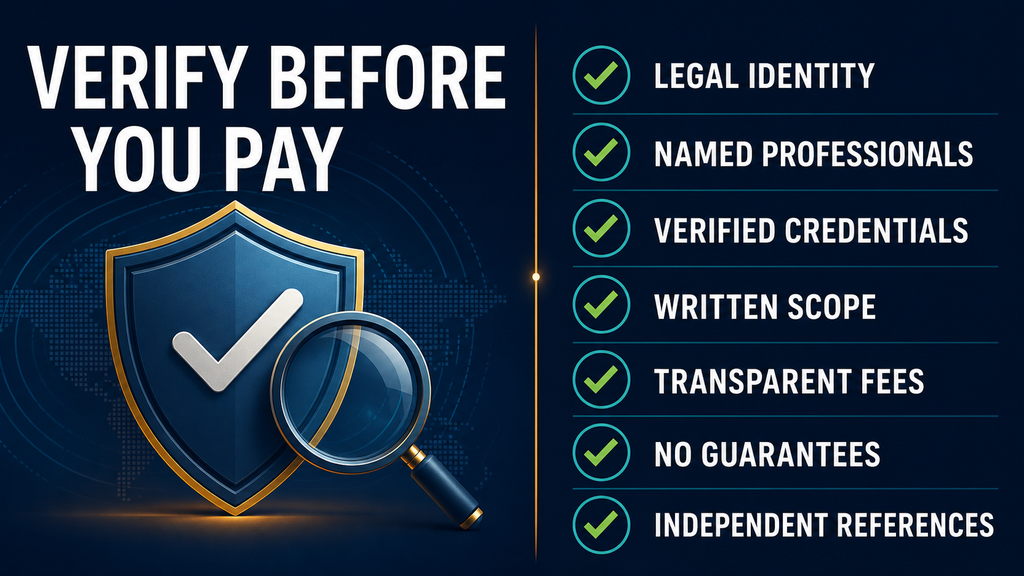
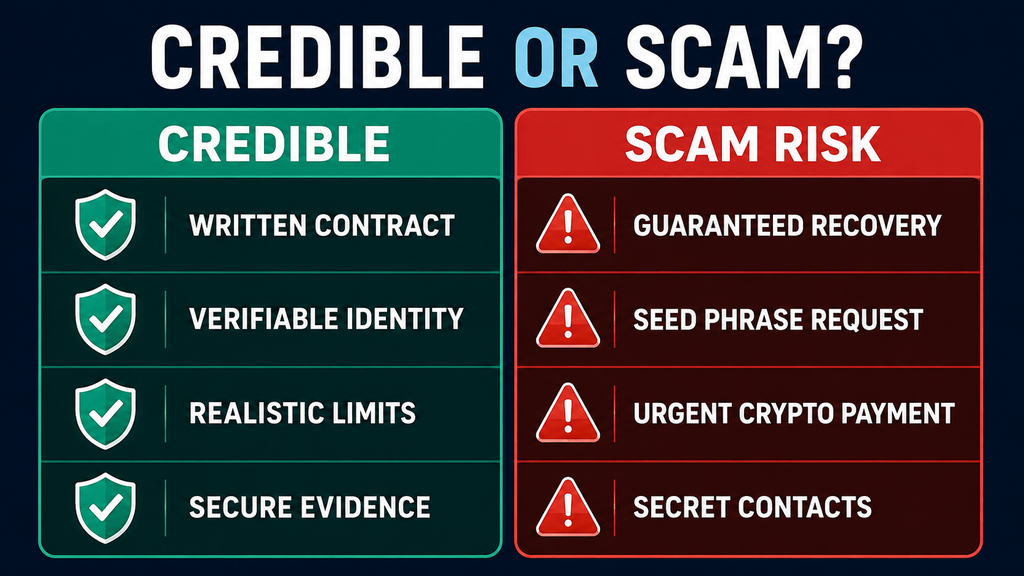
The direct answer is that a legitimate provider should have a verifiable legal identity, named professionals, a written scope of work, transparent fees and a realistic explanation of what may be possible. It should never guarantee recovery, claim it can reverse blockchain transactions, or ask for your seed phrase, private key, authentication code or unrestricted access to your device.
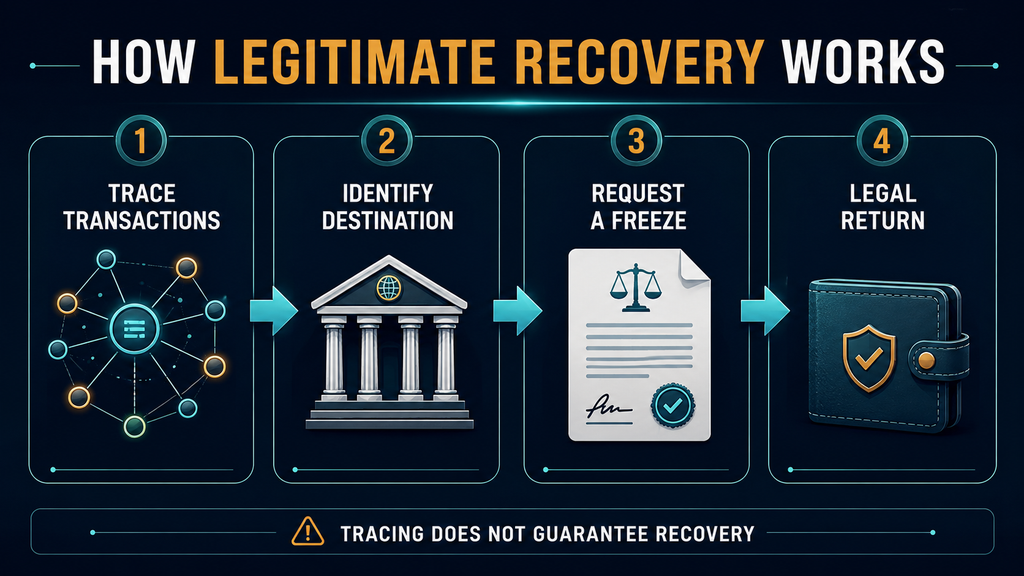
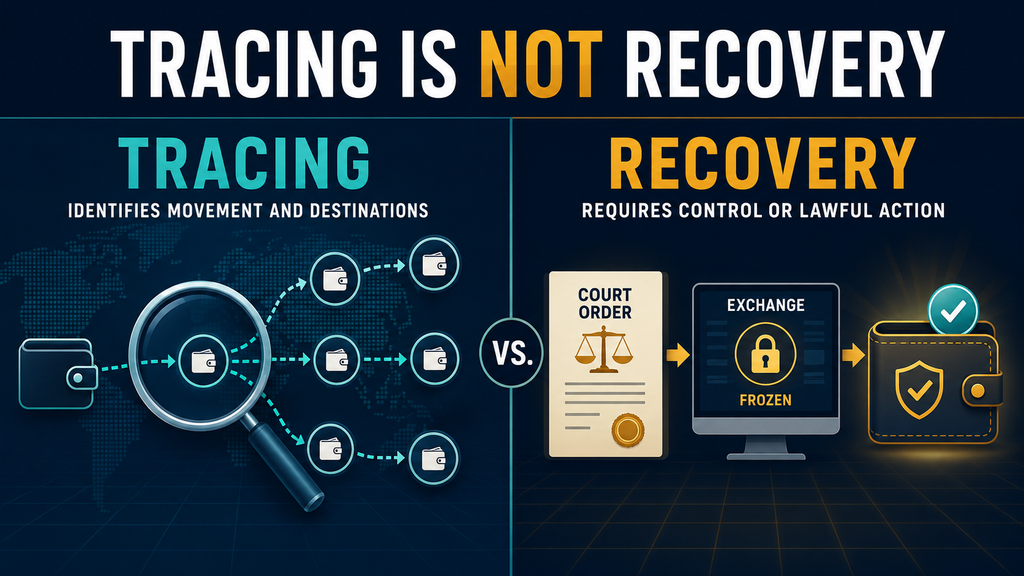
One detail I would not overlook is the difference between tracing cryptocurrency and recovering it. A private investigator may be able to follow transactions, but returning stolen assets usually requires cooperation from an exchange, a court, law enforcement or the person controlling the receiving wallet.
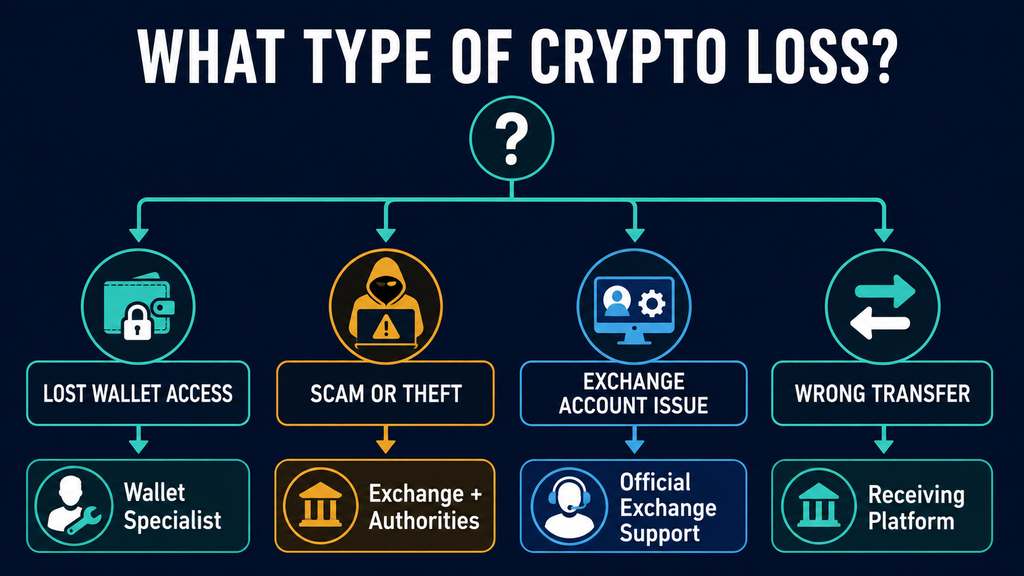
First Determine What Kind of Crypto Recovery You Need
The phrase “crypto recovery” covers several unrelated problems. Identifying your situation before contacting anyone can prevent you from hiring the wrong person or paying for a service that cannot help.
| Situation | What may be possible | Appropriate first step |
|---|---|---|
| Forgotten wallet password | Testing possible password combinations against an encrypted wallet file | Contact a qualified wallet-access specialist |
| Missing seed words | Limited reconstruction may be possible if enough information remains | Obtain a technical assessment |
| Damaged hardware wallet | Device repair or data extraction may be possible | Contact the manufacturer or a specialist laboratory |
| Stolen cryptocurrency | Funds may be traced, but recovery requires control or legal intervention | Contact the exchange and file official reports |
| Crypto sent to a scammer | Transaction tracing and exchange notification may help | Preserve evidence and report immediately |
| Transfer made on the wrong network | Recovery depends on the receiving address and platform | Contact the receiving wallet or exchange |
| Frozen exchange account | Verification or compliance review may resolve the problem | Use the exchange’s official support channel |
| Fake trading-platform balance | The displayed funds may never have existed | Stop paying and report the platform |
A wallet-access provider helps an owner regain access to cryptocurrency that has not moved. A blockchain investigator, by contrast, examines where stolen or transferred funds went. Neither service can lawfully “hack” another wallet and send the assets back.
How Legitimate Crypto Recovery Actually Works
Wallet-access recovery
Wallet-access recovery applies when your cryptocurrency remains in a wallet you own, but you cannot open it. Common examples include a forgotten password, an old encrypted wallet file, damaged hardware or an incomplete backup.
A technical specialist may use password-testing tools, file analysis or hardware examination. A reputable provider should explain what information it needs, how it will protect that information, and whether the work could damage the original device or data.
Blockchain tracing
Transactions on many public blockchains can be followed from one address to another. A forensic investigator may identify that the funds reached an exchange, bridge, mixer, gambling platform or another known service.
However, identifying a destination is not the same as controlling the destination. A tracing report may support an exchange investigation, insurance claim, legal action or law-enforcement request, but it does not itself retrieve the money.
Legal asset recovery
Actual recovery may involve an exchange freeze, a civil claim, a criminal investigation, a court order, forfeiture or a negotiated settlement. The available route depends on the evidence, the recipient’s location, the amount lost, the relevant jurisdiction, and whether the assets can still be identified.
Government-led recovery has occurred in some cases. For example, the Department of Justice has described using civil asset forfeiture to recover cryptocurrency fraud proceeds, but such cases involve formal legal procedures and do not mean that every victim will recover funds.
How to Find a Legitimate Crypto Recovery Service
1. Reject unsolicited recovery offers
Be extremely cautious if someone contacts you after you post about your loss on social media, a review site, Telegram, Reddit or a cryptocurrency forum. Scammers monitor these spaces and approach victims while pretending to be investigators, attorneys, ethical hackers or representatives of an exchange.
The FTC warns that a legitimate organization will not unexpectedly contact you and offer to recover your money for a fee. Its guidance on cryptocurrency recovery offers advises against paying anyone who contacts you with such a promise.
2. Verify the business’s legal identity
Do not rely solely on the company name displayed on its website. Look for its full legal name, registration number, jurisdiction, physical or registered address, owners, directors and named employees.
Check those details through the appropriate corporate registry. Business registration does not prove expertise or honesty, but mismatched company names, recently formed entities, fake addresses and hidden owners are significant warning signs.
3. Investigate the people behind the company
A legitimate provider should identify the professionals who will handle your case. Independently check their employment history, technical qualifications, legal licences, investigative licences, and professional memberships.
If someone claims to be an attorney, verify that person through the relevant official bar directory. If the company claims to employ licensed investigators, check the licensing authority rather than accepting a badge or certificate displayed on its website.
4. Search for regulatory warnings
Search the company’s legal name, trading name, website domain, telephone number and email address. Add words such as “warning,” “complaint,” “impersonation,” “lawsuit,” “scam” and “regulator.”
The SEC’s Public Alert: Unregistered Soliciting Entities database lists certain entities that falsely claim to be registered, licensed or located where they say they are. Absence from the database is not proof of legitimacy because a newly created operation may not have been reported yet.
5. Ask what the provider will actually do
A credible provider should classify your case before promising a solution. It should explain whether it offers wallet-password recovery, device examination, transaction tracing, evidence preparation, exchange coordination or legal representation.
Be suspicious of phrases such as “advanced hacking,” “special blockchain access,” “wallet synchronization” or “direct links to every exchange.” These phrases do not describe a verifiable or lawful recovery method.
6. Demand a written agreement
Ask for a written contract before sending money or sensitive information. The agreement should identify the legal entity, the professional handling the case, the services being provided, expected deliverables, fees, refund conditions, and data-security practices and limitations.
Some legitimate attorneys and forensic investigators charge assessment fees or retainers, so an upfront fee alone does not automatically prove fraud. The danger appears when the provider combines an advance payment with pressure, guaranteed results, cryptocurrency-only payment or unexplained additional charges.
7. Obtain an independent opinion
If the amount lost is substantial, consider asking an independently selected attorney whether a forensic investigation would be useful. The attorney should have relevant experience in fraud, cybercrime, digital assets or asset recovery.
Do not use a lawyer recommended exclusively by the recovery company without verifying that person separately. The FBI has warned that fictitious law firms target cryptocurrency scam victims by claiming they located funds and demanding more money to release them.
Questions to Ask Before You Pay
A professional should be prepared to answer detailed questions without rushing you. I recommend requesting the answers in writing so you can compare them with the final contract.
Ask the following questions:
- What is your complete registered business name?
- Who will personally work on my case?
- Which professional licences or credentials can I verify?
- Is my case technically recoverable, traceable or neither?
- What exact work will you perform?
- What will I receive at the end of the engagement?
- Do you provide a written forensic report?
- Which parts of the outcome depend on an exchange or court?
- What information will you need from me?
- How will you secure my identity and wallet data?
- What is the estimated total cost?
- Under what circumstances could the price increase?
- Can you guarantee any part of the result?
- Have your reports been accepted by attorneys, insurers, exchanges or authorities?
- What happens if you cannot identify a viable recovery route?
Pay attention to how the provider responds. Evasive answers, unexplained secrecy, pressure to act immediately or irritation when you ask for verification are good reasons to end the conversation.
Warning Signs of a Crypto Recovery Scam
Recovery fraud usually begins with hope. The person claims that your assets have already been located or that only one payment is needed to unlock them.
Common warning signs include:
- An unsolicited call, email, message or social-media comment
- A guarantee of full or partial recovery
- A promise to recover the funds within a fixed number of days
- Claims of secret access to an exchange or blockchain
- Claims of working directly with the FBI, IC3 or another authority
- Requests for a seed phrase or private key
- Requests for an exchange password or authentication code
- Requests to install remote-access software
- Demands for payment in cryptocurrency
- Additional tax, gas, liquidity, insurance or release fees
- Communication only through WhatsApp, Telegram or a generic email
- Pressure to keep the recovery confidential
- A website with no verifiable owners or professionals
- Testimonials that appear copied, repetitive or anonymous
- A claim that the provider can hack the receiving wallet
The CFTC’s warning about recovery fraud explains that these schemes frequently target people who have already lost money. The victim pays a fee for supposed recovery assistance, but the promised funds never arrive.
The FTC also explains that refund and recovery scams commonly demand an advance payment before supposedly returning lost money. Its recovery scam guidance recommends reporting these approaches rather than continuing to pay.
What to Do Before Hiring Anyone
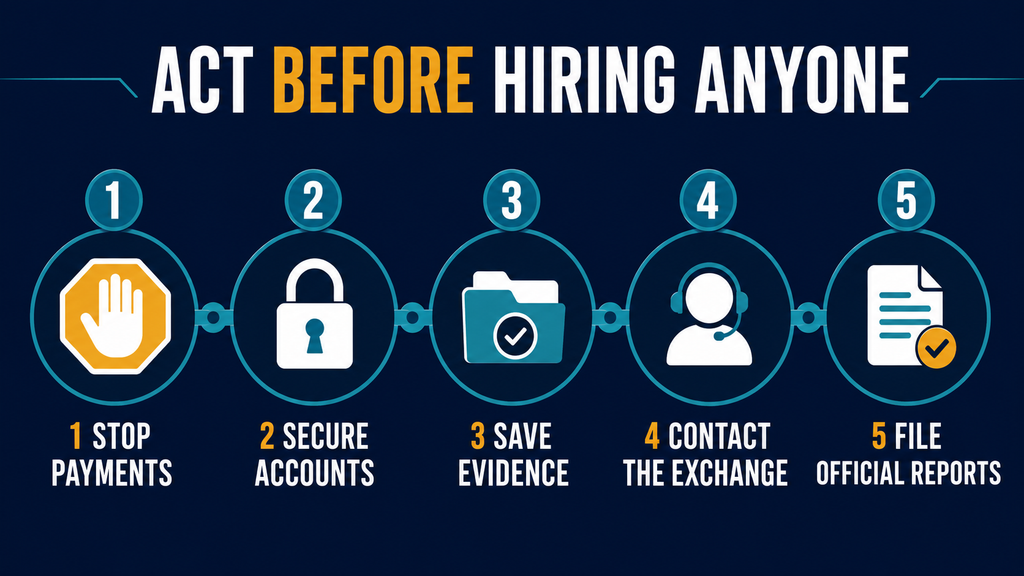
Stop sending money
Do not send another withdrawal charge, tax payment, security deposit, liquidity fee or wallet-activation payment. A fake platform can display any account balance it chooses, so numbers shown on a dashboard do not prove that real cryptocurrency is being held for you.
If the platform claims you must deposit more money before withdrawing your existing balance, compare its behavior with the warning signs in this independent crypto platform review. Continued payments often increase losses rather than releasing the displayed funds.
Secure your accounts
Change the passwords for affected email, banking, exchange and social-media accounts. Use a clean device, enable strong two-factor authentication and review recent sessions, forwarding rules, connected applications and approved withdrawal addresses.
If you disclosed a seed phrase or private key, assume that wallet is compromised. Seek guidance through the wallet provider’s official channel and move any remaining assets to a newly created secure wallet when it is safe to do so.
Preserve evidence
Create a chronological file containing:
- Transaction hashes
- Sending and receiving wallet addresses
- Asset names, networks, amounts and dates
- Bank and exchange records
- Emails, text messages and chat histories
- Social-media profiles and usernames
- Telephone numbers and email addresses
- Website domains and screenshots
- Contracts, invoices and payment requests
- Recovery offers received after the original loss
Keep original emails, documents and files whenever possible. Cropped screenshots may omit timestamps, addresses, headers or other information that investigators need.
Contact the exchange or payment provider
Contact the exchange, bank, card provider or cryptocurrency ATM operator involved in the payment. Use the contact details on the official website or application rather than information supplied by the suspected scammer.
Provide the transaction hash, wallet address, amount and time of the transfer. The platform may investigate or preserve records, although it may require an official legal request before freezing an account or disclosing customer information.
File official reports
The FBI advises victims to report cryptocurrency fraud promptly and provide detailed transaction information. Its guidance for cryptocurrency scam victims also warns that someone claiming to recover the funds may be operating another scam.
Filing a report does not guarantee an investigation or refund. However, it creates an official record and may help investigators connect your loss to other complaints involving the same addresses, websites or individuals.
Information You Should Never Share
Never send anyone your complete seed phrase, private key, exchange password, email password, authentication code or unrestricted remote access to your computer. Anyone with this information may be able to take control of your accounts or transfer your remaining cryptocurrency.
A wallet-access specialist may reasonably request an encrypted wallet file or information about possible password patterns. That is different from asking for a live wallet’s complete recovery phrase. Request a written explanation of why each piece of information is required and how it will be stored, used and deleted.
Preparing secure access arrangements in advance can reduce future recovery risks. If you hold digital assets as part of your estate, this guide to putting cryptocurrency in a trust explains the importance of trustee authority, custody arrangements and protected access instructions.
Tracing Cryptocurrency Is Not the Same as Recovery
Blockchain tracing can show how assets moved across public addresses. Depending on the available data, an investigator may identify an exchange, service, bridge or other destination connected to the funds.
Recovery requires something more. Someone must have lawful or practical control of the destination assets, such as a cooperative exchange acting on a valid request, a court-authorized seizure, a settlement or the voluntary return of the funds.
| Tracing may provide | Tracing cannot provide by itself |
|---|---|
| Transaction history | Reversal of a confirmed blockchain transaction |
| Destination addresses | Control of another person’s wallet |
| Links to known services | A guaranteed exchange freeze |
| Evidence for a report | A court order |
| Leads for investigators | Guaranteed repayment |
| A record of asset movement | Proof of the wallet owner’s identity in every case |
That is why a company promising “guaranteed recovery” before reviewing the transaction trail isn’t credible. Even an accurate forensic report cannot promise that the destination will remain funded or that an exchange or court will act.
How Much Does Crypto Recovery Cost?
There is no standard cost because the required work varies greatly. A wallet-password assessment may be relatively limited, while an international tracing investigation involving attorneys and court applications can become expensive.
Providers may charge:
- A fixed assessment fee
- An hourly professional rate
- A legal retainer
- A forensic-report fee
- A success-based fee
- A combination of fixed and conditional charges
Ask for an estimate of the total cost, not just the first payment. Compare that expense with the amount lost, the quality of your evidence and whether a realistic recovery route exists.
Do not borrow money or send additional cryptocurrency because someone says one final payment will release your funds. Repeated demands for taxes, gas fees, insurance, certificates or unlocking payments strongly suggest that the recovery itself is fictitious.
Frequently Asked Questions
Are there any legitimate crypto recovery companies?
Some wallet-access specialists, forensic investigators, attorneys and asset-recovery professionals provide genuine services. Their existence does not mean that stolen cryptocurrency can always be recovered, so you must independently verify their identities, credentials, methods, contracts and fees.
Can a crypto recovery company reverse a transaction?
A private company cannot simply reverse a confirmed transaction on a decentralized blockchain. Recovery normally requires control of the receiving wallet, cooperation from a custodial platform, voluntary repayment or lawful intervention.
Can an ethical hacker recover stolen cryptocurrency?
Treat claims about hacking funds back with extreme caution. Unauthorized access may be illegal, and many people advertising “ethical hacker recovery” are advance-fee scammers seeking another payment or access to your accounts.
Should I pay an upfront crypto recovery fee?
Some legitimate professionals charge retainers or assessment fees, so upfront payment is not conclusive proof of fraud. Do not pay if the provider also guarantees recovery, demands cryptocurrency, applies pressure or invents additional release and activation charges.
Can law enforcement recover stolen cryptocurrency?
Authorities may trace, freeze, seize and return cryptocurrency when the assets and responsible parties can be identified and legal requirements are satisfied. Reporting a loss does not guarantee recovery, but prompt and detailed reporting may improve the usefulness of your evidence.
What information does a crypto investigator need?
An investigator may need transaction hashes, public wallet addresses, exchange records, payment receipts, messages, screenshots, website details and a clear timeline. A legitimate investigator should not need your complete seed phrase, live private key, password or authentication code to trace public transactions.
How do I check whether a recovery company is real?
Verify its corporate registration, named employees, professional licences, office address, regulatory history, contract and fee structure through independent sources. Do not treat testimonials, social-media followers, badges or the company’s own website as sufficient proof.
Understanding how to find a legitimate crypto recovery provider
Understanding how to find a legitimate crypto recovery provider starts with realistic expectations. A genuine professional will clearly distinguish between wallet access, blockchain tracing, evidence preparation and legal recovery, while explaining that no particular result can be guaranteed.
I would start by stopping all further payments, securing your accounts, saving every transaction record and contacting the relevant exchange through its official channel. After filing appropriate reports, use the verification checklist in this guide before hiring anyone, and seek an independent legal opinion when the amount involved is significant.
This article provides general consumer-safety information. It is not legal, financial, investigative, or cybersecurity advice, and available recovery options may differ by circumstances and jurisdiction.