


Crypto Updates FTAsiaEconomy: Asia Crypto Trends in 2026
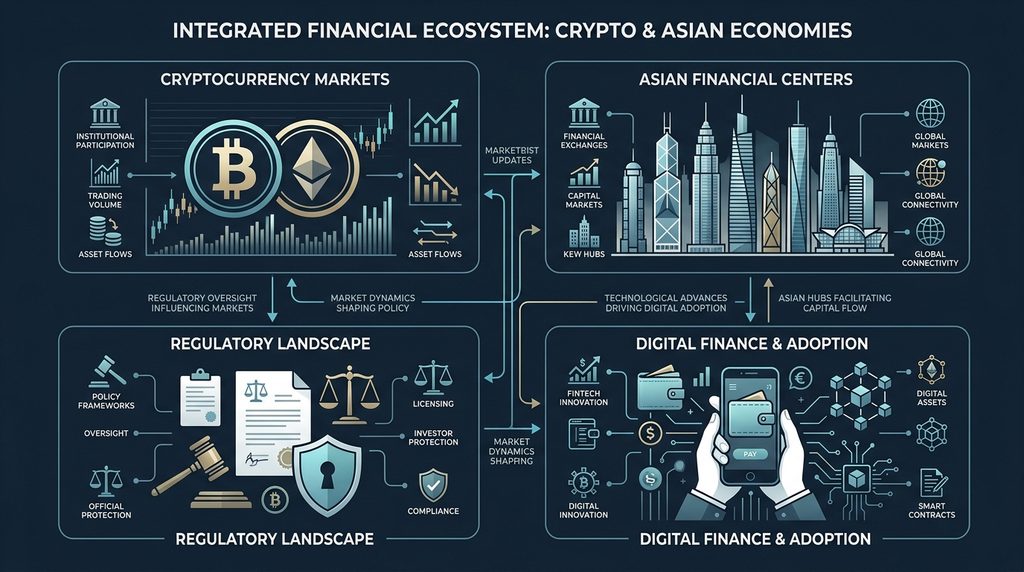
If you are searching for crypto updates ftasiaeconomy, you are probably looking for current information about cryptocurrency, regulation, adoption, stablecoins, and digital-finance developments across Asian markets. The important point is that this phrase is not a standard financial term or a universally recognized market indicator. Current search results use it as a label for Asia-focused crypto and financial content, often covering Bitcoin, Ethereum, regulation, fintech, and blockchain trends.
That distinction matters because crypto information can become outdated quickly. Instead of repeating generic claims about the future of digital assets, this guide focuses on developments you can verify through regulators, financial institutions, and established industry research. The goal is to help you understand what is actually changing, why it matters, and which signals are worth watching.
What Does Crypto Updates FTAsiaEconomy Actually Mean?
First, understand the search intent behind this keyword. People using the phrase may be looking for a particular FTAsiaEconomy article, but they may also simply want a current overview of Asian cryptocurrency trends.
Current search results contain several different websites using variations of “FTAsiaEconomy,” “FTAsiaEconomy crypto trends,” and “Crypto Updates Ftasiaeconomy.” Because the phrase appears across multiple domains and articles, I would not treat the keyword itself as proof that one authoritative organization is behind every result.
That is one reason source quality matters. A page can rank for a phrase while still making claims that have not been checked against regulators, legislation, financial institutions, or original research.
The more useful interpretation is therefore:
crypto updates ftasiaeconomy = current Asia-focused cryptocurrency, blockchain, fintech, regulatory, and digital-finance developments.
That broader interpretation also matches the topics repeatedly associated with the search term, including Bitcoin, Ethereum, stablecoins, institutional adoption, DeFi, CBDCs, tokenization, and cryptocurrency regulation.
Why Asian Crypto Markets Deserve Attention
Asia has become one of the most important regions for cryptocurrency adoption and digital-asset activity.
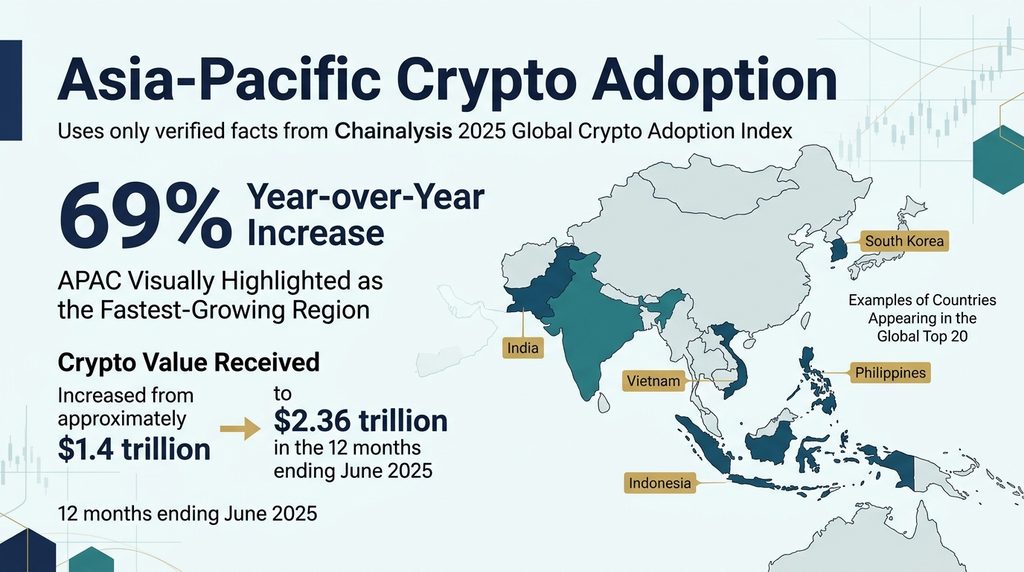
According to the Chainalysis 2025 Global Crypto Adoption Index, Asia-Pacific was the fastest-growing region for on-chain crypto activity in the 12 months ending June 2025. The region’s value received increased 69% year over year, rising from about $1.4 trillion to $2.36 trillion.
This data matters not just because more cryptocurrency is moving through the region. It shows that Asia contains a mixture of large retail markets, fast-growing digital economies, sophisticated financial centers, and jurisdictions experimenting with different regulatory models.
That makes the region particularly important for anyone following crypto updates.
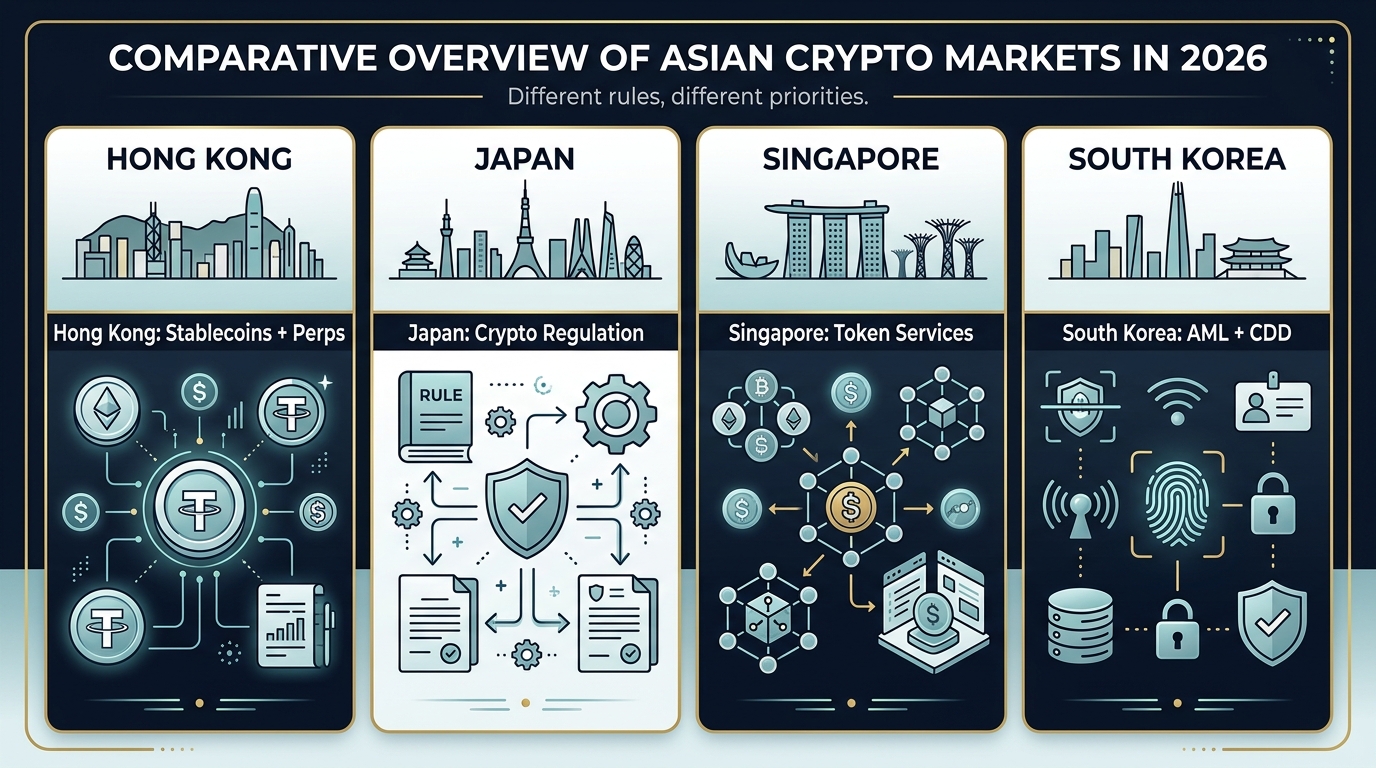
India, Pakistan, Vietnam, Indonesia, the Philippines, South Korea, Japan, Singapore, and Hong Kong each have different market structures and regulatory environments. A development in one country therefore cannot automatically be applied to another.
The Biggest Crypto Developments to Watch in 2026
Rather than trying to predict which coin will rise next, it is more useful to monitor structural changes. Regulation, access to financial products, stablecoin infrastructure, custody, and institutional participation can influence the market for much longer than a single day’s price movement.
Here are the developments I would watch most closely.
1. Hong Kong Is Expanding Its Regulated Digital-Asset Framework
Hong Kong continues to build a regulated market for virtual assets rather than treating cryptocurrency as purely speculative.
In February 2026, the Hong Kong Securities and Futures Commission introduced initiatives allowing licensed brokers to provide certain virtual-asset financing services and established a framework for licensed trading platforms to consider perpetual contracts for professional investors. The framework includes requirements around product design, disclosures, valuation, margining, collateral, and liquidation.
Stablecoins are another major part of the story. Hong Kong’s Stablecoins Ordinance created a regulatory framework for licensed stablecoin issuers, while the SFC and HKMA published guidance in May 2026 covering activities involving relevant stablecoins issued by licensed entities.
The lesson is important: regulated crypto infrastructure is becoming more sophisticated. That does not make digital assets risk-free, but it changes the types of products and businesses that can develop around them.
2. Japan Is Moving Crypto Further Into the Financial-Regulatory Framework
Japan has also been making significant changes to its approach to crypto assets.
The Japan Financial Services Agency’s 2026 report on crypto-asset systems outlines the work of its Working Group on Crypto-asset Systems. The report was published in February 2026 and updated on August 3, 2026.
The broader direction is important. Japan has been examining crypto assets not only from the perspective of payment systems but also in light of their growing role as investment assets.
Japan has also updated its travel-rule framework for certain crypto and electronic-payment-instrument transfers. The finalized changes took effect on August 3, 2026.
For users and businesses operating across borders, this type of change can matter just as much as price movements.
The lesson is simple: when following crypto news from Japan, look beyond Bitcoin prices and pay attention to licensing, custody, transfer requirements, investor protection, and how financial law treats digital assets.
3. Singapore Is Combining Access With Strong Oversight
Singapore takes another important position in Asia’s digital-asset landscape.
The Monetary Authority of Singapore Financial Institutions Directory currently lists regulated institutions providing Digital Payment Token services. The directory lets you check whether a company holds the relevant authorization, rather than relying solely on claims on a company’s website.
That distinction is extremely useful for crypto users.
A company describing itself as a crypto platform does not automatically mean that it is regulated for every service it offers. Checking the regulator’s directory is therefore one of the simplest ways to verify an important claim.
Singapore’s government-backed MoneySense service also warns clearly about crypto risk. Its Risks of Digital Tokens guidance says crypto derivatives can be volatile and leveraged and warns that regulation does not eliminate the possibility of losing money.
That is an important point for anyone reading bullish crypto headlines. Regulation can establish rules and oversight, but it cannot guarantee that an asset will retain its value.
4. South Korea Is Tightening Compliance Requirements
South Korea is another market worth monitoring closely.
In August 2026, South Korea’s Financial Services Commission announced approved rule changes designed to strengthen registration and anti-money-laundering requirements for virtual asset service providers.
The South Korea Financial Services Commission announcement on VASP registration and AML requirements describes stronger registration requirements, enhanced AML duties for virtual-asset transfers, and expanded customer due diligence requirements.
This illustrates an important trend across Asia: crypto regulation is increasingly moving beyond whether cryptocurrency should be allowed.
Regulators are focusing more closely on who can provide services, how customers are identified, how transactions are monitored, and how cross-border transfers are handled.
That shift is likely to remain an important part of crypto news throughout 2026.
Stablecoins May Be More Important Than the Next Altcoin
One of the most useful shifts in crypto research is moving beyond the question, “Which coin will go up?”
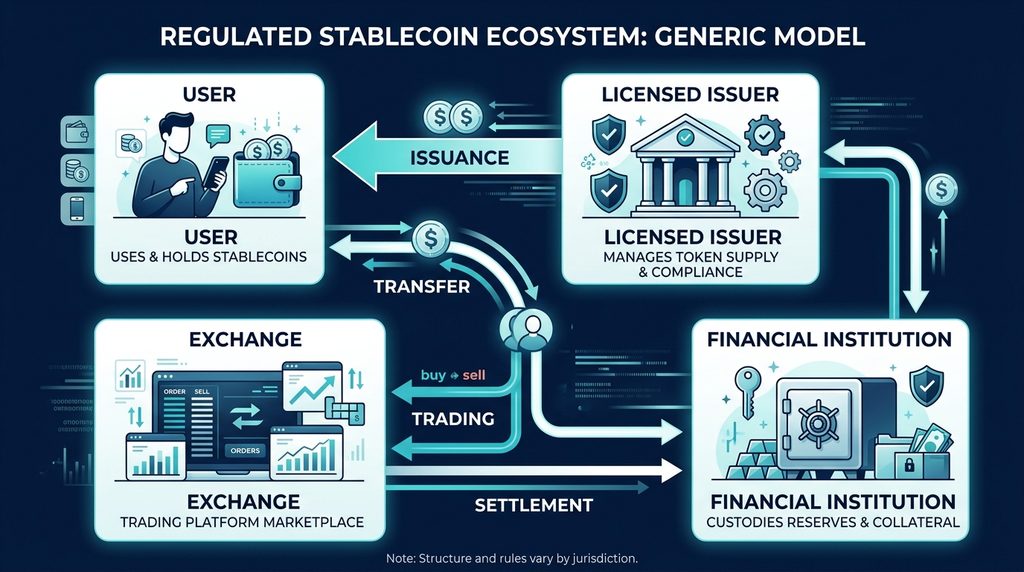
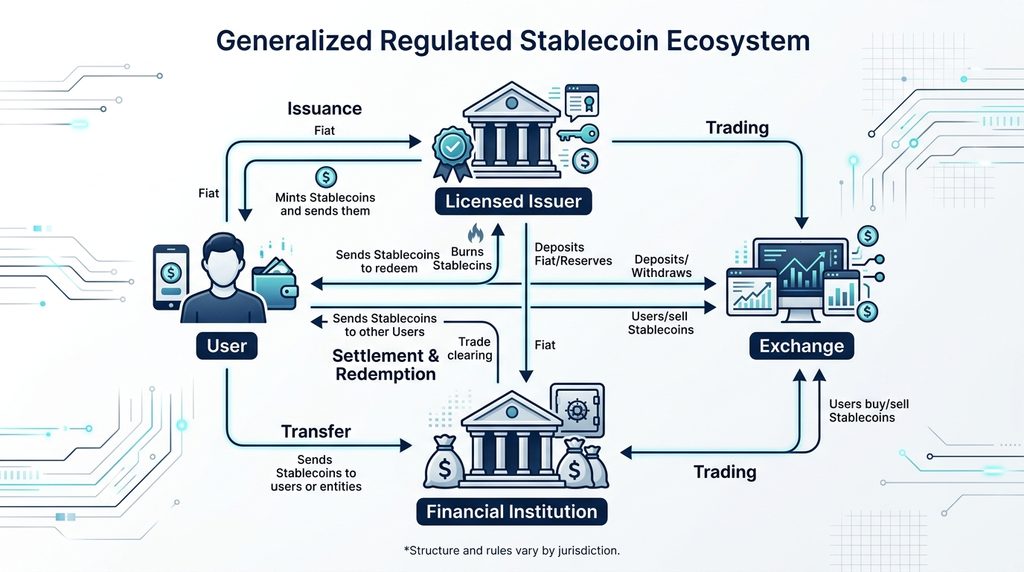
Stablecoins deserve attention because they connect blockchain infrastructure with payments, trading, settlement, and financial services. They are designed to maintain a relatively stable value against a reference asset, usually a fiat currency, although their stability depends on their structure, reserves, governance, liquidity, and regulatory framework.
Hong Kong’s 2026 regulatory developments show how seriously policymakers are treating this area. The HKMA has been developing the licensing framework for stablecoin issuers, while the SFC has issued guidance for licensed platforms and corporations dealing with relevant stablecoins.
Japan is also incorporating stablecoins into its regulatory and transaction-monitoring framework. Its 2026 travel-rule changes specifically refer to electronic payment instruments, including stablecoins.
For anyone following crypto updates ftasiaeconomy, this is a better signal than simply watching an altcoin ranking. Ask what stablecoins are being used for, which entities can issue them, how reserves are managed, and what activities licensed institutions are permitted to provide.
Bitcoin and Ethereum Still Matter, But Context Matters More
Bitcoin and Ethereum remain central reference points for crypto-market analysis. However, focusing only on daily price movements can obscure the broader shifts around them.
Bitcoin is increasingly discussed alongside institutional access, custody, regulated investment products, and macroeconomic conditions. Ethereum is relevant not only as an asset but also because its blockchain supports smart contracts, decentralized applications, tokenization, and other digital-finance infrastructure.
Recent market conditions also demonstrate why context matters. Reuters reported in early September 2026 that Bitcoin had experienced a substantial rally while still facing technical resistance and uncertainty around interest-rate expectations.
That is a useful reminder not to treat a price increase as proof that the underlying market has become safer or that a trend will continue.
When I read crypto market updates, I would separate three questions:
| Question | What to examine |
|---|---|
| What happened? | Price, volume, regulatory announcement or product launch |
| Why did it happen? | Macro conditions, liquidity, demand, policy or technology |
| Does it matter long term? | Adoption, infrastructure, regulation and actual usage |
This approach makes crypto research much less reactive.
What to Watch Beyond Bitcoin
The strongest crypto analysis should not become a list of token predictions. Several structural themes are more useful to follow.
Institutional Adoption
Institutional adoption includes banks, asset managers, payment companies, custodians, and other established financial businesses developing digital-asset products or infrastructure.
The key question is not simply whether an institution has entered crypto. Ask what it is actually doing. Custody, settlement, tokenization, trading, payments, and investment products have very different implications.
Tokenization
Tokenization involves representing assets or claims digitally on a blockchain. It can potentially apply to securities, funds, commodities, deposits, and other financial instruments.
The important development is not the word “tokenization” itself. Look for evidence of real issuance, settlement, secondary trading, custody, and regulatory treatment.
DeFi
Decentralized finance remains an important part of the blockchain ecosystem, but it also carries substantial smart-contract, liquidity, governance, counterparty, and market risks.
A high yield is not automatically evidence of a strong protocol. Before considering a DeFi project, examine how it generates yield, what collateral supports it, who controls critical contracts, and what happens during extreme market conditions.
CBDCs
Central bank digital currencies should not be confused with decentralized cryptocurrencies. A CBDC is issued or backed by a central bank, while decentralized cryptocurrencies such as Bitcoin operate through blockchain networks without a central issuer controlling the ledger.
This distinction becomes especially important when comparing Asian digital-finance strategies.
How to Evaluate a Crypto Update Before Trusting It
A good crypto update should tell you what happened, identify its source, distinguish fact from interpretation, and explain what remains uncertain.
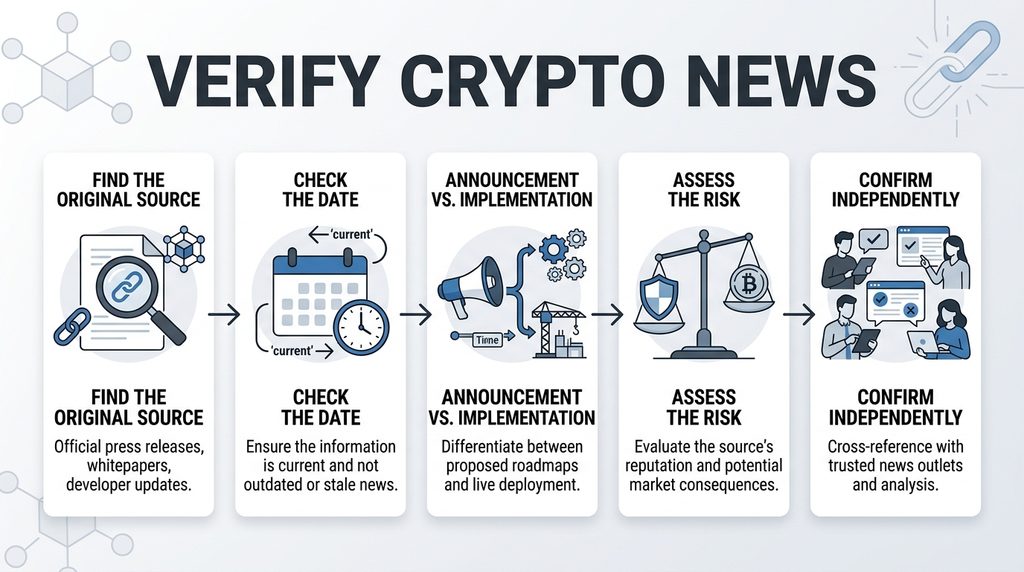
I recommend using this five-step process.
1. Find the Original Source
If an article says a regulator approved something, look for the regulator’s announcement. If it says a company launched a product, check the company’s official announcement or relevant filing.
This is particularly important with crypto because headlines can turn consultations into “new laws” or preliminary applications into “approved licenses.”
2. Check the Date
A regulation from 2024 may be irrelevant to a question about the market in 2026. Look for publication dates, effective dates, consultation deadlines, and implementation dates.
3. Separate Announcement From Implementation
A proposal is not a final rule. A license application is not an approved license. A partnership announcement is not necessarily evidence of a live product.
This simple distinction can prevent many surprising bad conclusions.
4. Check the Risk
Ask whether the update changes:
- Investor access
- Exchange requirements
- Custody rules
- Stablecoin issuance
- Tax treatment
- Market structure
- AML requirements
- Product availability
- Institutional participation
Not every crypto headline has a meaningful market impact.
5. Look for Independent Confirmation
For major developments, I prefer at least one primary source plus independent reporting. This is especially useful when the announcement comes from a company that has an obvious commercial interest in the story.
Common Mistakes When Following Crypto News
Treating Every Market Move as a Fundamental Change
Bitcoin can move because of macroeconomic expectations, liquidity, positioning, derivatives, or news sentiment. A short-term price move does not automatically mean adoption has changed.
Confusing a Regulatory Proposal With a Final Rule
This is particularly dangerous when reading international crypto news. Always check whether a proposal has been approved, when it takes effect, and which companies or assets fall within its scope.
Assuming One Asian Market Represents the Whole Region
Hong Kong, Japan, Singapore, and South Korea have different regulatory structures and market characteristics. A service available in one jurisdiction may be restricted or unavailable in another.
Relying on Anonymous Crypto Predictions
Price targets are opinions, even when presented with complicated charts. I would give much more weight to observable developments such as licensing, transaction activity, product launches, custody infrastructure, and regulatory changes.
Ignoring Security
Even when an exchange or service operates within a regulated framework, individual crypto holdings can still face market, operational, cybersecurity, custody, and transaction risks.
Pointed Editorial’s guide on how to put crypto in a trust is useful for readers who are thinking beyond market movements and want to understand the practical side of organizing digital assets for estate planning.
What Could Drive the Next Phase of Asian Crypto Growth?
The next stage may be less about launching another cryptocurrency and more about integrating blockchain infrastructure with existing financial systems.
Three areas deserve particular attention.
First, regulated access. Financial institutions need clear rules before they can commit significant resources to custody, trading, tokenization, and payment infrastructure.
Second, practical utility. Cross-border payments, settlement, tokenized assets, and stablecoins have clearer potential use cases than projects whose only selling point is speculative price appreciation.
Third, compliance infrastructure. As regulators strengthen customer identification, travel-rule requirements, custody standards, and market-conduct rules, businesses that can operate within those frameworks may have an advantage over projects built around regulatory uncertainty.
That does not guarantee that crypto prices will rise. It simply means the underlying industry is becoming more connected to the formal financial system.
How Pointed Editorial Fits Into Crypto Research
For readers who want practical rather than hype-driven digital-finance information, Pointed Editorial is building coverage around cryptocurrency, Web3, finance, and emerging financial technology.
Its existing content already includes practical guidance on digital-asset ownership and crypto social media management, alongside broader cryptocurrency and blockchain topics. The site’s stated editorial approach emphasizes explaining complicated financial technology in accessible language while distinguishing facts, company claims, professional opinions, and uncertainty.
That distinction matters in crypto because readers often encounter a mix of genuine financial reporting, marketing material, anonymous predictions, and recycled articles in the same search results.
Frequently Asked Questions
What are crypto updates ftasiaeconomy?
crypto updates ftasiaeconomy is a search phrase associated with content about cryptocurrency, blockchain, financial technology, and digital-asset developments across Asian markets. It is better treated as a topic or search label than as a standardized financial term.
Is FTAsiaEconomy an official crypto regulator?
No. Don’t confuse it with a government regulator or financial authority. When a crypto article claims licensing, regulation, taxation, or investor protection, verify it against the relevant official authority.
What are the most important Asian crypto trends in 2026?
Regulatory development, stablecoins, institutional digital-asset infrastructure, tokenization, custody, compliance, and practical blockchain applications are among the most important themes. Regional crypto adoption also remains significant, with APAC showing strong growth in Chainalysis’s 2025 adoption research.
Which Asian markets should crypto investors watch?
Hong Kong, Japan, Singapore, and South Korea are particularly useful markets to monitor because each is developing a distinct regulatory and financial approach to digital assets. Their differences can be more informative than treating Asia as one unified market.
Are crypto regulations becoming stricter in Asia?
In several major markets, regulators are becoming more detailed rather than simply more restrictive. Recent developments include stronger AML and customer due diligence requirements in South Korea, expanded regulatory frameworks in Hong Kong, and further development of Japan’s crypto-asset rules.
Are stablecoins the next major crypto trend?
Stablecoins are an important area to watch because they connect blockchain technology with payments, trading, settlement, and financial services. Their development is increasingly tied to licensing, reserve, custody, and consumer-protection rules, particularly in regulated Asian financial centers.
Should I make an investment decision based on crypto news alone?
No. News can help you identify developments worth researching, but it does not replace due diligence. Digital assets can be highly volatile, so evaluate the asset, platform, custody arrangements, regulatory position, security risks, and your own financial circumstances before deciding.
Conclusion: Follow the Signal, Not the Hype
The most useful way to understand crypto updates ftasiaeconomy is to look beyond the keyword and examine the real developments behind it. Asian cryptocurrency markets are evolving through regulation, stablecoins, institutional infrastructure, tokenization, compliance, and changing consumer adoption.
Hong Kong is developing regulated digital-asset products and stablecoin infrastructure. Japan is refining its crypto regulatory framework. Singapore continues to operate a structured licensing environment for digital-payment-token services, while South Korea is strengthening AML and customer due diligence requirements.
The bigger lesson is that crypto research should be evidence-led. Instead of chasing the loudest price prediction, check the original announcement, verify the date, understand what has actually been implemented, and look for independent confirmation.
If you want a clearer way to follow cryptocurrency, blockchain, and digital-finance developments, keep exploring Pointed Editorial’s practical crypto coverage and use the verification framework in this guide whenever a new market headline catches your attention.