


Buying Property in Portugal with Crypto: What You Need to Know in 2026
Buying property in Portugal with crypto is possible, but the phrase can make the process sound simpler than it really is. You cannot assume that sending Bitcoin from your wallet to a seller is enough to become the registered owner of a Portuguese home.
A compliant transaction still has to satisfy property-law requirements, tax rules, anti-money-laundering checks, source-of-funds verification, and the formal deed and registration process. In many cases, the easiest structure is to convert the cryptocurrency through an authorized crypto-asset service provider and complete the property purchase in euros.
Yes, cryptocurrency can fund the purchase of Portuguese property. Depending on the structure, the crypto may be converted into euros before closing or, in some cases, transferred directly as part of an exchange-style transaction. Either way, expect full KYC, source-of-funds checks, Portuguese property taxes, a formal deed, and conventional land registration.
This article is general educational information rather than individualized legal, tax, investment, or immigration advice. Crypto-funded real estate deals can create consequences in more than one jurisdiction, so professional advice should be obtained before committing funds.
Is It Legal to Buy Property in Portugal Using Cryptocurrency?
Yes. Portugal has already seen real estate transactions involving cryptocurrency, and there is no blanket rule preventing digital assets from being used to fund a property acquisition.
What matters is how the transaction is structured.
Portugal’s property system still requires the transaction to be documented properly and the new owner’s rights to be registered. You will also need a Portuguese tax identification number, or NIF. Portugal’s government confirms that both residents and non-residents can request a Portuguese NIF.
The crypto component does not replace the normal conveyancing process. The property must still move legally from the seller to the buyer, and the relevant taxes must be calculated using euro values.
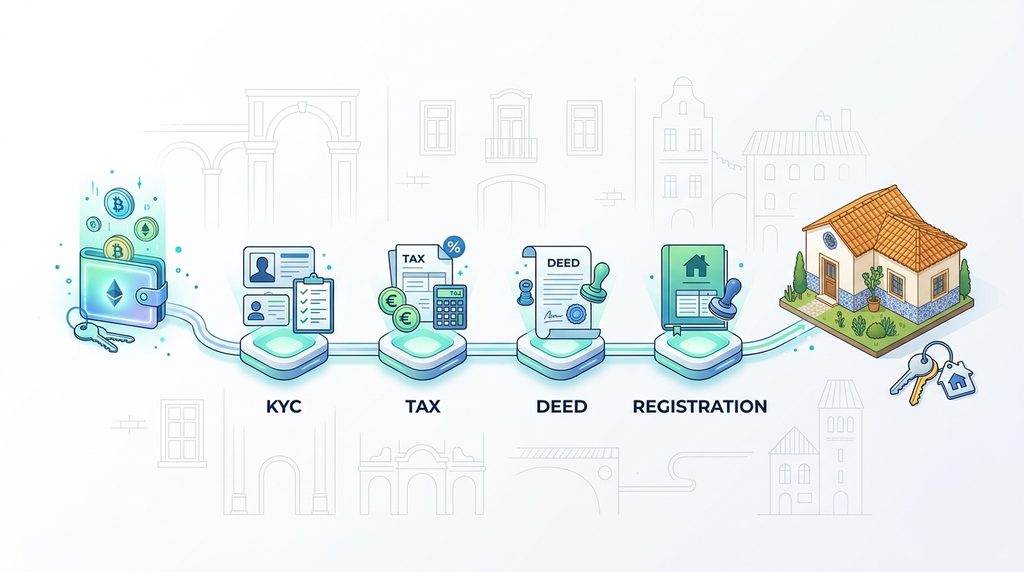
Buying Property in Portugal with Crypto: The Two Main Routes
There is an important difference between a crypto-funded property purchase and a property transaction in which the seller actually receives cryptocurrency.
Understanding that distinction can save considerable confusion later.
Route 1: Convert Crypto to Euros Before Closing
For many buyers, this is the cleaner route.
You transfer cryptocurrency to an appropriately authorized crypto-asset service provider, complete its compliance checks, sell or convert the assets, and use the resulting euros for the property transaction.
The seller therefore receives euros even though your wealth originally came from Bitcoin, Ethereum, stablecoins, or another digital asset.
This approach usually fits more naturally into the conventional property process because the purchase price, taxes, deed, and settlement can all be handled in euros.
It does not, however, eliminate crypto-related tax consequences. Converting the assets may itself constitute a disposal for tax purposes.
Route 2: The Seller Accepts Cryptocurrency
A more unusual arrangement occurs when the seller agrees to receive cryptocurrency directly.
Because cryptocurrency is not simply treated as ordinary euro payment for every legal purpose, transactions of this kind may need to be structured as an exchange or permuta. Portuguese real estate company Zome describes a process involving a crypto-asset exchange transaction supported by legal compliance and source-of-funds checks.
The exact structure should be agreed among the buyer, seller, Portuguese lawyer, notary or authorized professional, and any regulated crypto intermediary before the promissory contract is signed.
I would not transfer a large crypto deposit merely because a seller says they accept Bitcoin. The contract needs to define exactly what asset will be transferred, which network will be used, how its euro value will be determined, when the transfer becomes final, and what happens if the transaction fails.
The 2026 Rules Buyers Should Not Overlook
A considerable amount of online information about Portugal and cryptocurrency was written between 2021 and 2024. Several important assumptions from those articles should no longer be carried forward without checking them.
MiCA Authorization Now Matters
The European Union’s Markets in Crypto-Assets Regulation, known as MiCA, substantially changed the regulatory environment for crypto service providers.
The transitional period for previously operating providers ended on July 1, 2026. ESMA has specifically stated that providers lacking the required authorization after the transition should wind down unauthorized EU crypto-asset services. ESMA maintains a public MiCA register of authorized crypto-asset service providers.
That makes provider verification a practical part of due diligence.
- Its exact legal entity name
- Which regulator authorized it
- Which crypto services it may provide
- Whether the authorization is still active
- Which entity will actually custody or convert your assets
- The receiving wallet address and network
- Conversion spreads and transaction fees
- Withdrawal and settlement procedures
An old statement that a business was a Portuguese “registered VASP” should not be treated as sufficient evidence of its regulatory status today.
Non-Resident Residential IMT Can Be 7.5%
This is another major area where older property guides can be outdated.
Portugal’s current IMT rules provide a 7.5% rate for certain acquisitions of urban residential property by buyers who are non-resident for Portuguese tax purposes, subject to specific exceptions. The current Portuguese IMT code includes exceptions relating, among other circumstances, to becoming Portuguese tax resident within two years and qualifying housing-rental arrangements.
This distinction concerns tax residence rather than nationality.
Do not estimate your acquisition costs from an older online IMT calculator without confirming your current status. On a high-value purchase, using the wrong IMT assumption can create a very large budgeting error.

Buying Property Does Not Create a Golden Visa Investment
This point deserves special attention because old Portugal investment articles still appear in search results.
Portugal’s current ARI investment rules state that qualifying investment activity cannot be directed, directly or indirectly, toward real estate investment. The current AIMA investment-residence requirements therefore should be checked separately from any property purchase.
Owning a Portuguese property and qualifying for Portuguese residence are two different questions.
Step-by-Step: How a Crypto-Funded Purchase Can Work
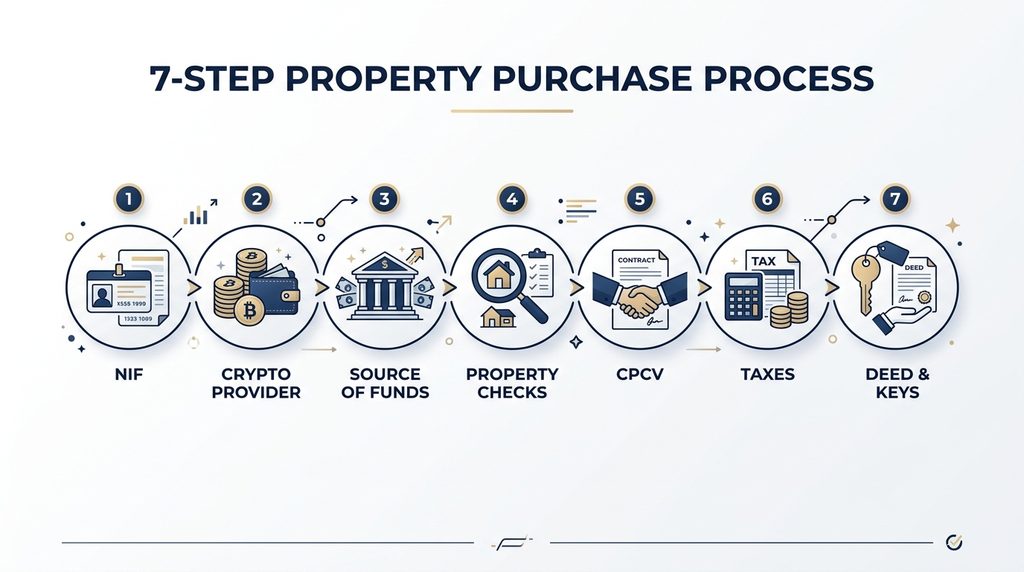
A carefully structured transaction usually looks much more like a conventional Portuguese property purchase than a blockchain transaction.
1. Get Your NIF
Start with the Portuguese tax identification number.
Do this before your transaction becomes urgent. The NIF is used throughout Portuguese financial, contractual, and tax processes.
2. Decide Whether You Will Convert or Transfer Crypto
Make this decision early.
- The seller wants only euros
- The seller is genuinely willing to receive crypto
- Your chosen asset has sufficient liquidity
- Your crypto provider supports the required transaction size
- Your lawyer and notary will accept the proposed structure
- Your tax adviser has reviewed the crypto disposal
For many buyers, converting through a regulated provider and completing the purchase conventionally will be operationally simpler.
3. Complete KYC and Source-of-Funds Checks Early
Do not wait until the week of completion.
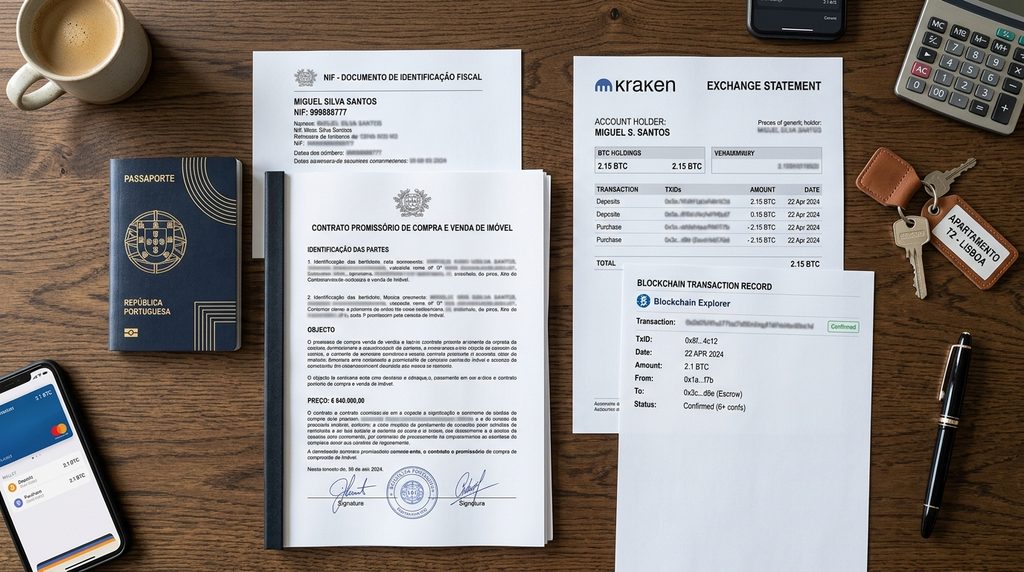
Crypto wealth often requires more documentation than money that has been sitting in the same traditional bank account for years. Compliance professionals may need to understand where the assets came from and how they moved between wallets.
Useful evidence can include:
- Exchange account statements
- Purchase histories
- Wallet addresses
- Blockchain transaction records
- Records showing transfers between your own wallets
- Mining or staking records where applicable
- Employment or business records if income funded the purchases
- Earlier tax filings
- Documents relating to inherited or gifted crypto
- Evidence explaining large incoming wallet transfers
Blockchain transparency does not automatically prove lawful ownership. A transaction hash may show where coins moved, but compliance teams may still need documents explaining why you received them.
4. Carry Out Independent Property Due Diligence
The crypto payment should never distract you from the property itself.
Your legal representative should investigate ownership, registered charges, mortgages, tax information, planning issues, condominium matters where relevant, and other documentation appropriate to that property.
Portugal’s Justice Ministry provides the official process for Portuguese property registration. The ultimate goal is conventional legal ownership recorded through the property-registration system, not ownership represented merely by a blockchain transaction.
5. Negotiate the Promissory Contract Carefully
Many Portuguese purchases involve a Contrato-Promessa de Compra e Venda, commonly called a CPCV.
In a crypto-funded transaction, the agreement deserves additional attention. It should deal with the payment method rather than assuming everything will operate like an ordinary euro transfer.
Possible issues include:
- Euro purchase price
- Crypto asset to be used
- Pricing source
- Conversion time
- Who bears network fees
- Who bears conversion fees
- Wallet details
- Confirmation requirements
- Failed or delayed transfers
- Crypto volatility
- Refund mechanism
- Compliance failure
- Completion deadline
Never copy a conventional property contract and simply replace “euros” with “Bitcoin.”
6. Pay the Property Taxes
Crypto does not remove the standard taxes attached to acquiring Portuguese real estate.
The Portuguese Tax Authority states that a property buyer generally needs to deal with IMT and Stamp Duty, with the relevant payment or exemption evidence available for completion. Stamp Duty on the acquisition is normally 0.8% of the applicable taxable value. Portugal’s Tax Authority explains the property-purchase taxes here.
The precise IMT calculation needs to reflect the property type, intended use, purchase value, taxable property value, residence position, and any applicable special rule.
7. Complete the Deed and Register Ownership
Once compliance, legal checks, taxes, and payment arrangements are ready, the transaction can proceed to formal completion.
The ownership change is then registered through Portugal’s normal property system. Your crypto transaction may explain where the purchase funds originated, but it does not substitute for the deed and registration.
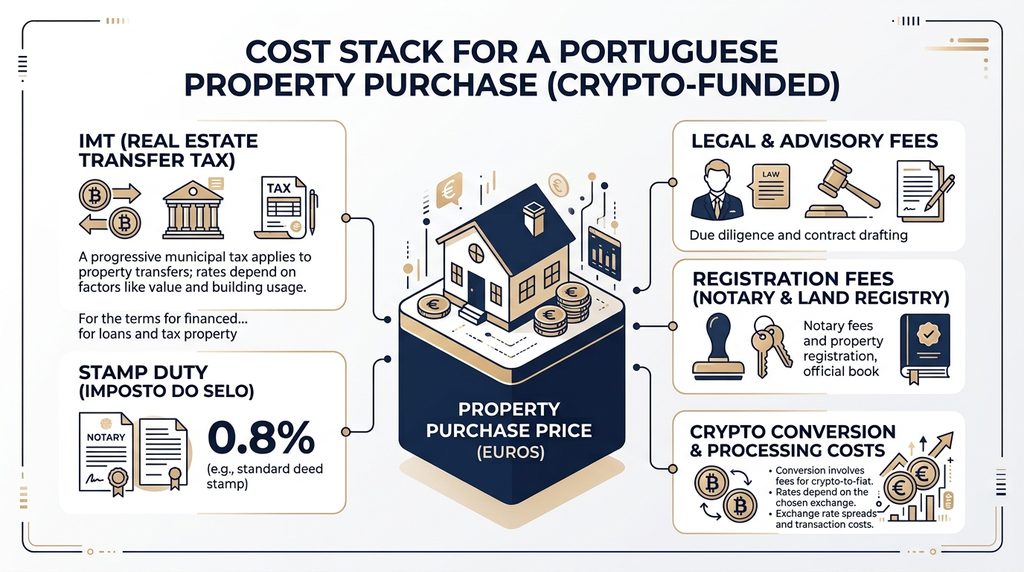
Taxes and Costs When Buying With Crypto
There are really two financial events to consider: disposing of the cryptocurrency and acquiring the property.
Treating only the second one as taxable is a common mistake.
| Cost or tax | What to know |
|---|---|
| IMT | Portuguese property transfer tax. Rate depends on the transaction and buyer’s circumstances, including current rules affecting certain non-residents. |
| Stamp Duty | Generally 0.8% on the relevant property acquisition value. |
| Lawyer/legal review | Varies by provider and transaction complexity. Crypto transactions may require additional compliance work. |
| Deed and registration | Depends on the route and services used. |
| Crypto conversion | Provider fees, spreads, custody, network, or settlement costs may apply. |
| Crypto capital gain | Converting or using appreciated crypto may create a taxable disposal depending on your tax residence and circumstances. |
| Currency conversion | May apply if your financial arrangements involve another fiat currency before euro settlement. |
Can Using Crypto Trigger Capital Gains Tax?
Potentially, yes.
If you are Portuguese tax resident, the Portuguese Personal Income Tax Code currently provides special rules for qualifying cryptoassets. Gains from qualifying assets held for at least 365 days can be excluded under the conditions set out in Article 10, while taxable qualifying gains can fall under the 28% autonomous rate. There are important exceptions involving the type of cryptoasset and relevant jurisdictions. Portugal’s current crypto capital-gains provisions and the corresponding tax-rate rules should therefore be considered together.
One detail I would not overlook is that buying a house with crypto is not the same thing as exchanging one cryptocurrency for another cryptocurrency. Portugal’s crypto-to-crypto rule should not simply be assumed to defer tax when the asset you receive is real estate.
If you are tax resident elsewhere, that jurisdiction may also treat transferring or converting your crypto as a taxable disposal. Cross-border tax advice is therefore particularly valuable before you move the assets.
Readers organizing substantial digital holdings may also find Pointed Editorial’s guide to putting cryptocurrency in a trust useful for broader estate-planning considerations, although trust ownership and Portuguese property ownership require separate professional analysis.
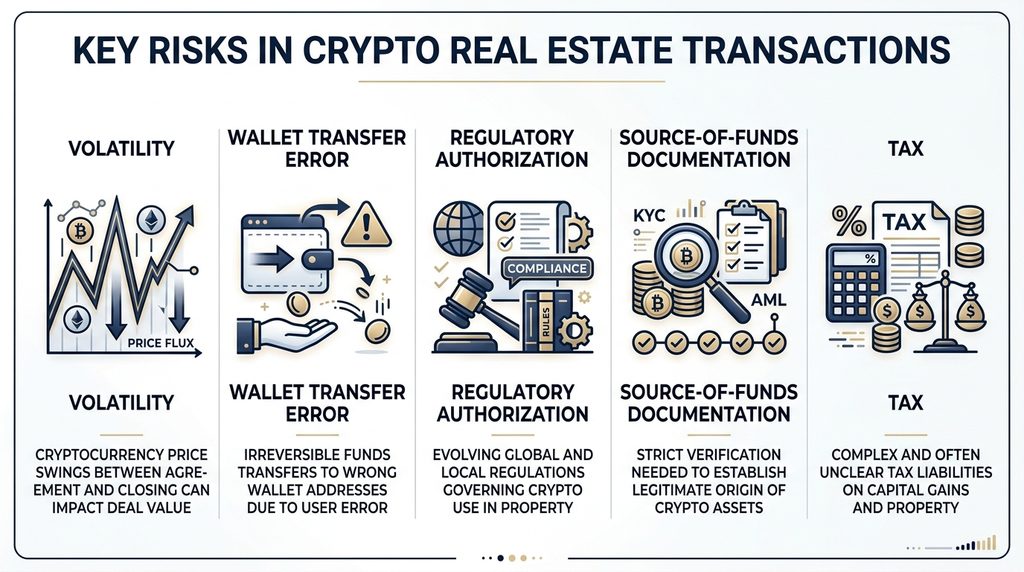
Biggest Risks of a Crypto Property Purchase
Crypto can make the funding method faster in some circumstances, but it can also introduce risks that conventional property buyers do not face.
Price Volatility
Suppose the property price is agreed at €600,000 while the deposit is held in a volatile cryptocurrency.
If the asset drops substantially before completion, the seller still expects the agreed property value unless your contract says otherwise. Decide whether the crypto amount will be fixed, recalculated, or converted earlier.
Stablecoins may reduce market-price volatility, but they introduce issuer, reserve, custody, regulatory, and de-pegging risks of their own.
Sending Crypto to the Wrong Wallet
Traditional banking errors sometimes have recovery procedures. Blockchain transfers can be far harder or impossible to reverse.
Verify wallet addresses independently, confirm the blockchain network, use controlled procedures, and consider a small verification transfer when the transaction structure permits it.
Choosing an Unauthorized Provider
This risk deserves more attention after the end of the MiCA transition period.
Check the actual legal entity rather than relying on a logo, marketing statement, or the fact that the business operated legally several years ago.
Poor Source-of-Funds Records
Someone who bought Bitcoin many years ago and moved it through several self-custody wallets may genuinely own the assets but struggle to document their history.
Organize the evidence before finding the property. Trying to reconstruct a decade of wallet movements three days before closing is a bad position to be in.
Forgetting Tax on the Crypto Side
A buyer may carefully budget IMT and Stamp Duty yet completely overlook the disposal of appreciated cryptocurrency.
Have the crypto disposal analyzed before signing a binding property agreement.
Is It Better to Pay Directly in Crypto or Convert First?
For most buyers, I would start by asking whether direct crypto settlement produces a meaningful advantage.
The answer will depend on your seller, tax position, custody setup, banking arrangements, and professional advisers.
| Approach | Potential advantage | Main drawback |
|---|---|---|
| Crypto converted to euros | Fits conventional property settlement more easily | Conversion creates fees and may trigger a taxable disposal |
| Direct crypto transfer | May reduce some fiat-transfer steps where seller accepts crypto | More unusual legal structure and greater contract/compliance complexity |
| Stablecoin-funded conversion | Lower short-term volatility than BTC or ETH | Issuer, custody, compliance, and conversion risks remain |
| Convert well before purchase | Gives certainty about your euro property budget | Removes exposure to any later crypto price increase |
There is no universal advantage in making the transaction “as crypto as possible.”
The best structure is usually the one that leaves the buyer with clear title, documented source of funds, manageable tax consequences, predictable closing funds, and as few points of failure as possible.
Frequently Asked Questions
Can you really buy a house in Portugal with Bitcoin?
Yes. Bitcoin can be used to fund a Portuguese real estate purchase, either through conversion into euros or, in less common cases, through a transaction where the seller accepts crypto. The legal, tax, compliance, deed, and registration requirements still apply.
Do I need a Portuguese bank account to buy property with crypto?
A Portuguese bank account is not the same thing as a legal requirement to own property, and some crypto-funded transaction structures may operate without one. However, a bank account can still be practically useful for taxes, bills, property expenses, refunds, or the settlement arrangement, so confirm the proposed flow with your lawyer and provider before assuming you can avoid banking entirely.
Can I buy Portuguese property with USDT or USDC?
Potentially, provided the seller or authorized intermediary supports the asset and the transaction satisfies compliance requirements. Stablecoins can reduce the price volatility associated with Bitcoin or Ethereum, but they still carry issuer, custody, regulatory, and de-pegging risks.
Is cryptocurrency tax-free in Portugal after 365 days?
That statement is too broad. Portugal currently excludes certain gains on qualifying cryptoassets held for at least 365 days, subject to conditions and exceptions, but asset type, tax residence, jurisdiction, and the nature of the activity can change the outcome.
Does buying a house in Portugal give me residency?
No. Property ownership and immigration status should be treated separately. Portugal’s current ARI investment rules specifically prevent qualifying investment activity from being directed directly or indirectly toward real estate.
How do I prove the source of crypto used to buy property?
Keep exchange statements, acquisition records, public wallet addresses, transaction histories, tax records, and documents explaining significant incoming transfers. A blockchain transaction record proves movement between addresses, but compliance professionals may still require evidence showing how you originally obtained the assets.
Is buying property with crypto anonymous?
No. A legitimate Portuguese property transaction is not an anonymous way to convert cryptocurrency into real estate. Expect identity verification, beneficial-ownership checks where relevant, source-of-funds documentation, tax records, a formal deed, and property registration.
Conclusion: Prepare the Crypto Before You Choose the House
Buying property in Portugal with crypto is now a real option, but it works best when the digital-asset side is prepared before the property contract becomes binding. Verify your provider’s current authorization, document the history of the crypto, understand the tax consequences of disposing of it, calculate current Portuguese property taxes, and make sure your lawyer and closing professional approve the settlement structure.
I would start with three conversations: a Portuguese property lawyer, a tax professional familiar with digital assets and your tax residence, and a MiCA-authorized crypto provider capable of handling the transaction size. Once those pieces fit together, you can search for property knowing how much crypto can actually become usable purchasing power at closing.
For more practical coverage of cryptocurrency, regulation, security, and digital finance, explore Pointed Editorial’s crypto guides.