


What Crypto Should I Be Investing In DrHCryptology?
- No single cryptocurrency suits every investor.
- Our research found no independently verifiable DRHCryptology model portfolio or personalized coin recommendation.
- Bitcoin and Ethereum may be sensible starting points for research because they have longer operating histories and more established networks, but neither is safe or guaranteed to rise.
- Solana, Chainlink and other altcoins can provide exposure to different blockchain uses, but they generally introduce greater technical, market and token-specific risks.
- Never buy a cryptocurrency solely because an influencer, website or social-media account predicts rapid gains.
- Your financial position, time horizon, risk tolerance and ability to withstand a complete loss should determine whether you invest in crypto at all.
If you searched “what crypto should I be investing in DrHCryptology,” the most responsible answer is to begin by researching Bitcoin and Ethereum rather than immediately buying a long list of speculative tokens. Bitcoin offers exposure to a decentralized monetary network, while Ethereum provides exposure to smart contracts and blockchain applications.
That does not mean either asset is guaranteed to perform well. Crypto remains speculative, and an appropriate allocation could be small or even zero depending on your finances and risk tolerance. Before investing, verify the asset’s purpose, supply, security, decentralization, liquidity and custody requirements. Never invest money you need for bills, emergencies, or short-term goals.
What Does the DRHCryptology Search Mean?
People searching for “what crypto should I be investing in DrHCryptology” appear to be looking for cryptocurrency recommendations associated with the DRHCryptology name.
The DRHCryptology website publishes educational material about cryptocurrency, blockchain, investment strategies and security. However, during our review, we did not find a transparent, independently verifiable model portfolio showing exactly which cryptocurrencies the site currently recommends, when it selected them, or how those selections have performed.
Other websites have attributed recommendations for Bitcoin, Ethereum, Solana and several altcoins to DRHCryptology. Readers should treat those claims cautiously unless they can trace them to an original, dated statement from the named source.
This distinction matters. A coin list copied from another website may be outdated, incorrectly attributed or published primarily to attract search traffic. Don’t treat it as personalized investment advice.
So, What Cryptocurrency Should You Research First?
For someone learning about cryptocurrency, Bitcoin and Ethereum are usually more logical research starting points than newly launched or thinly traded tokens. They represent two different investment theses and have longer operating records than most crypto assets.
| Cryptocurrency | Main investment thesis | Potential strengths | Important risks |
|---|---|---|---|
| Bitcoin (BTC) | Scarce, decentralized digital asset and payment network | Long operating history, fixed maximum supply and broad recognition | Severe volatility, limited native programmability and uncertain future valuation |
| Ethereum (ETH) | Infrastructure for smart contracts and decentralized applications | Large application ecosystem, staking and programmable blockchain | Competition, smart-contract risks, complexity and changing network economics |
| Solana (SOL) | High-throughput smart-contract network | Fast transactions, relatively low fees and active application ecosystem | Greater platform-specific risk and a shorter history than Bitcoin or Ethereum |
| Chainlink (LINK) | Decentralized data and interoperability infrastructure | Connects blockchain applications with external data and systems | Token-value capture, competition and dependence on broader smart-contract adoption |
| Stablecoins | Digital tokens designed to track another asset, usually a currency | Useful for transfers, trading and temporary settlement | Issuer, reserve, de-pegging, regulatory and platform risks |
None of these descriptions constitutes a recommendation to buy. The table is a starting point for comparing fundamentally different crypto assets.
1. Bitcoin: The Most Established Research Starting Point
Bitcoin was introduced as a peer-to-peer electronic cash system that could transfer value without a financial institution approving each transaction. Its original design is explained in the Bitcoin white paper.
Bitcoin’s supply rules limit the maximum number of coins to 21 million. This predictable issuance policy supports the argument that Bitcoin can function as a scarce digital asset. It also has a longer operating history than other widely traded cryptocurrencies.
Those strengths do not make Bitcoin a low-risk investment. Its market price can fall sharply, its valuation is influenced heavily by investor demand, and it does not generate business earnings or contractual cash flow. The SEC’s investor education office describes Bitcoin and Ether as highly speculative, including when exposure is obtained through an exchange-traded product.
Bitcoin may deserve consideration when an investor:
- Understands why fixed supply does not guarantee price appreciation
- Can tolerate substantial and prolonged declines
- Has a long investment horizon
- Wants exposure to a decentralized monetary network
- Is prepared to learn secure custody practices
It may be inappropriate for money needed for an emergency fund, debt repayment, education, a home deposit or another near-term obligation.

2. Ethereum: Exposure to Programmable Blockchain Infrastructure
Ethereum differs from Bitcoin because its primary purpose is not simply to transfer a scarce digital asset. It is a programmable network on which developers can create smart contracts, decentralized financial applications, tokenized assets and other blockchain-based services.
Ethereum uses proof-of-stake. Validators commit ETH to the protocol and may lose part of that stake if they behave dishonestly. The official Ethereum proof-of-stake documentation describes the process.
An investment in ETH is therefore partly a bet that Ethereum will remain important infrastructure for on-chain activity. Investors may also stake ETH to participate in network validation, directly or through third-party services.
Staking rewards should not be confused with guaranteed interest. ETH’s price can decline by more than the rewards you earn. Third-party staking may also introduce counterparty, liquidity, smart-contract and custody risks.
Before buying ETH, investigate:
- How Ethereum transaction fees work
- The role of ETH within the network
- Staking rewards and penalties
- Layer-2 networks and their effect on Ethereum activity
- Competition from other smart-contract platforms
- Wallet and smart-contract security risks
Ethereum may offer broader technological exposure than Bitcoin, but its investment case is also more complicated.
3. Should You Invest in Solana or Other Altcoins?
Solana is a smart-contract network built for high transaction throughput and relatively low fees. It has attracted activity across decentralized finance, payments, trading, gaming and consumer applications.
Its potential appeal comes with additional risk. Solana has a shorter operating history than Bitcoin and Ethereum, and its long-term value depends on sustained users, developers, applications and economic activity. Investors must also examine network reliability, validator distribution, token issuance and competition.
The same principle applies to other altcoins. A promising technology does not automatically produce a valuable token. Ask why the token must exist, who receives it, how new supply enters circulation and whether demand for the product creates demand for the token.
Altcoins can experience dramatic price increases, but they can also lose most of their value or become illiquid. A portfolio containing ten speculative tokens is not necessarily well diversified if all ten respond to the same crypto-market conditions.
A Better Way to Choose a Cryptocurrency
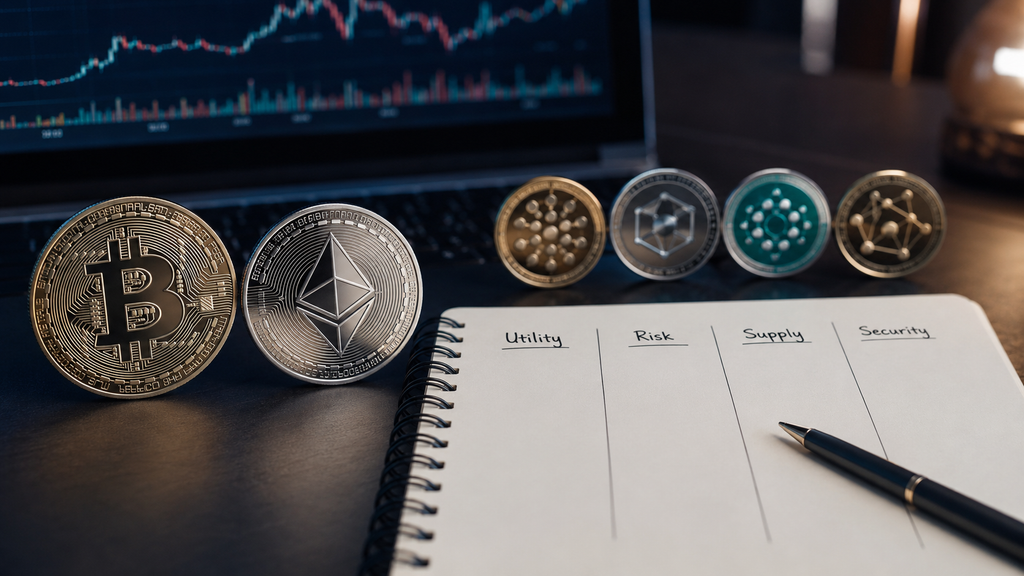
Instead of asking which coin could rise fastest, investigate whether the asset has a credible reason to retain value.
Understand the project’s purpose
Explain the project in one or two sentences without relying on promotional language. If you cannot identify the problem it solves or why a blockchain is necessary, you probably do not understand the investment well enough.
Examine token utility
Using a blockchain application does not always require holding its native token as a long-term investment. Determine whether the token pays network fees, secures the protocol, provides governance rights or performs another essential function.
Review supply and distribution
Check the maximum or expected supply, current circulation, future token unlocks and allocation to founders, insiders and early investors. Large unlocks can increase selling pressure.
Evaluate security and decentralization
Research previous outages, exploits and governance disputes. Determine who can update the protocol, freeze transactions, alter supply rules or control important infrastructure.
Check liquidity
Low trading volume can make entering or leaving a position difficult. A quoted market price is less meaningful if only a small quantity can be sold near that price.
Study the competition
A technically impressive network can still be a poor investment if competing platforms attract more developers, liquidity or users. Compare the project with realistic alternatives.
Identify the investment thesis
Write down why you are considering the asset, what evidence would support the thesis and what development would invalidate it. “The price is rising” is momentum, not a complete investment thesis.
How Much of Your Portfolio Should Be in Crypto?
There is no universal allocation. Someone with expensive debt, no emergency savings, or an upcoming financial obligation may reasonably hold no cryptocurrency. Someone with a diversified conventional portfolio and a high tolerance for loss may choose a limited speculative allocation.
FINRA explains that asset allocation and diversification can help manage investment risk, although they cannot eliminate it. Diversification should extend across asset classes, not merely across several cryptocurrencies.
Before choosing an amount, ask:
- Could I meet my essential expenses if this investment went to zero?
- Do I have accessible emergency savings?
- Am I carrying high-interest debt?
- When might I need this money?
- How would I respond to a 50% to 80% decline?
- Is the rest of my portfolio diversified?
- Do I understand the tax consequences of buying, selling and exchanging crypto?
If a major decline would cause you to sell in panic, miss payments or lose sleep, the proposed position is probably too large.
Is Dollar-Cost Averaging Better Than Buying at Once?
Dollar-cost averaging means investing a fixed amount at regular intervals instead of committing the entire amount on one date. It can reduce the emotional pressure of trying to identify a perfect entry price.
It does not prevent losses. Regularly purchasing an asset that continues to decline can still produce a poor result. The strategy controls purchase timing, not investment quality.
A rules-based approach may nevertheless help long-term investors avoid impulsive decisions driven by fear of missing out. Decide the amount, frequency, eligible assets and circumstances under which purchases would stop before market excitement takes over.
Crypto Custody Is Part of the Investment Decision
Choosing a token is only one part of crypto investing. You must also decide how to hold the asset.
Leaving assets with a centralized platform is convenient, but it introduces counterparty risk. Self-custody gives the owner direct control but also creates responsibility for protecting private keys and recovery information. Lost or exposed credentials can lead to irreversible loss.
The SEC’s crypto custody bulletin recommends understanding the differences between self-custody and third-party custody before choosing how to hold crypto assets.
Important safety practices include:
- Use a unique password for every financial account.
- Enable strong multi-factor authentication.
- Never disclose a seed phrase or private key.
- Confirm wallet addresses and networks before transferring funds.
- Test unfamiliar transfers with a small amount.
- Bookmark official websites instead of following links from messages.
- Keep long-term recovery instructions secure and accessible to the appropriate person.
Long-term holders should also consider incapacity and inheritance. Pointed Editorial’s guide on how to put crypto in a trust explains why estate documents, ownership structures and access instructions must be coordinated carefully.
Warning Signs That a Crypto Recommendation Is Unreliable
Be cautious when a website, influencer or private group:
- Guarantees a particular return
- Claims a coin cannot fall
- Creates pressure to buy immediately
- Promotes an unknown token without discussing supply or liquidity
- Receives undisclosed compensation
- Uses screenshots instead of independently verifiable records
- Asks you to transfer funds to a personal wallet
- Demands more money before allowing a withdrawal
- Requests your password, private key or seed phrase
- Claims to possess secret information unavailable to the market
A professional-looking website does not prove that a platform or recommendation is legitimate. If you are evaluating an unfamiliar service, use the verification process in this Monteriqo review as a practical example of checking ownership, regulation, withdrawal conditions and public evidence.
If you have already lost funds, watch out for people promising guaranteed retrieval. Read how to find a legitimate crypto recovery provider before paying a recovery fee or sharing sensitive information.
A Simple Crypto Research Checklist
Before buying any cryptocurrency, confirm that you can answer these questions:
| Question | What to verify |
|---|---|
| What does the network do? | Its purpose and actual need for blockchain technology |
| Why does the token have value? | Utility, demand and relationship to network activity |
| Who controls the project? | Founders, foundation, governance and administrative powers |
| How is supply distributed? | Circulating supply, maximum supply and future unlocks |
| Is the market liquid? | Trading volume, available markets and realistic exit conditions |
| Has it suffered failures? | Exploits, outages, de-pegging events and governance disputes |
| Where will it be stored? | Exchange, custodian or self-custody arrangements |
| What could invalidate the thesis? | Competition, regulation, technical failure or declining use |
| Can you afford a total loss? | Effect on bills, savings, debt and essential goals |
If the answers remain vague, delay the purchase. Missing an opportunity is usually less damaging than buying an asset you do not understand.
Frequently Asked Questions
What crypto should I be investing in according to DRHCryptology?
Our research did not identify a transparent, independently verifiable current portfolio from DRHCryptology. Other articles associate the name with Bitcoin, Ethereum, Solana and various altcoins, but readers should not treat those claims as confirmed personalized recommendations. Research each asset independently.
What is the best cryptocurrency for a beginner?
There is no universally best cryptocurrency. Bitcoin and Ethereum are common starting points for research because of their longer histories, established networks and broader availability. Both remain volatile and speculative.
Is Bitcoin safer than altcoins?
Bitcoin has a longer operating history and greater recognition than most altcoins, but “safer” does not mean safe. Its price can decline sharply, and holders face custody, fraud and regulatory risks.
Should I buy Bitcoin or Ethereum?
Bitcoin and Ethereum represent different theses. Bitcoin focuses on decentralized value transfer and scarce digital supply. Ethereum supports programmable smart contracts and decentralized applications. Some investors research both, but the appropriate choice depends on the investor’s objectives and risk tolerance.
How many cryptocurrencies should I own?
Owning more tokens does not automatically improve diversification. Several crypto assets can fall together during market stress. Focus on understanding each holding and maintaining diversification outside cryptocurrency.
Can I earn guaranteed income by staking crypto?
No. Staking rewards are not guaranteed investment returns. Token prices can fall, rewards can change, and validators or third-party services may introduce slashing, liquidity, smart-contract and counterparty risks.
Is it too late to invest in cryptocurrency?
No one can reliably determine whether a specific day is too early or too late. Instead of basing a decision on recent price performance, evaluate the asset’s fundamentals, your time horizon and the size of loss you can tolerate.
The Right Crypto Decision Starts With Research
The best answer to “what crypto should I be investing in DrHCryptology” is not a list of tokens to purchase immediately. It is a disciplined research process.
Bitcoin and Ethereum are reasonable places to begin learning because they represent established but different blockchain investment cases. Solana, Chainlink and other altcoins may provide exposure to additional technologies, but they also carry higher project-specific risks.
Don’t assume an online coin list reflects an authentic DRHCryptology recommendation. Verify the original source, publication date, methodology and possible financial incentives. More importantly, decide whether cryptocurrency fits your financial situation.
A sensible crypto decision begins with emergency savings, manageable debt, diversified finances, secure custody and an amount you can afford to lose completely. If you need advice based on your income, debts, tax position and goals, consult a qualified financial professional rather than relying on an online prediction.
This article is provided for general educational and informational purposes only. It does not constitute personalized financial, investment, legal or tax advice.