


D.C. Bar Ethics Opinion 378 Cryptocurrency: A Legal Fees Guide
Yes, a lawyer can accept cryptocurrency for legal fees under the framework explained in D.C. Bar Ethics Opinion 378 cryptocurrency guidance. But the arrangement matters: paying an existing dollar invoice differs from handing over crypto before the lawyer performs the work.
The official D.C. Bar Ethics Opinion 378, published in June 2020, permits cryptocurrency payments subject to ethical safeguards. This guide explains the payment categories, written agreement, custody questions, and practical checks to address before transferring digital assets.
Legal information notice: This article provides general educational information, not individualized legal or tax advice. Applicable professional rules and the facts of your engagement determine your obligations.
What D.C. Bar ethics opinion 378 cryptocurrency guidance covers
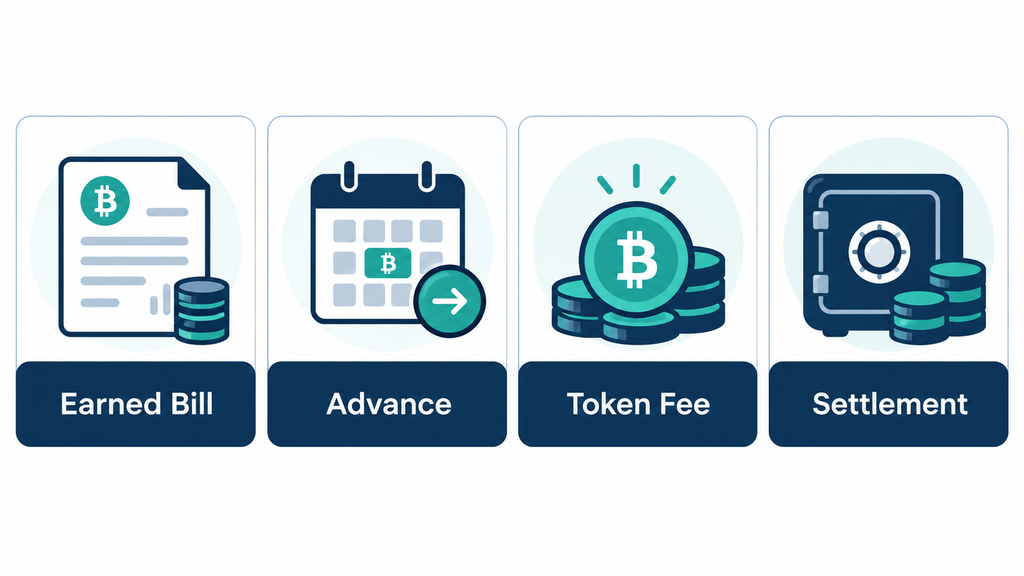
The opinion addresses accepting cryptocurrency as payment for legal services and safeguarding client cryptocurrency. Its central distinction is whether crypto simply settles an already earned dollar bill or creates an ongoing financial interest through an advance or a fee calculated in tokens.
| Payment arrangement | Treatment under Opinion 378 | Main issue to resolve |
|---|---|---|
| Crypto equivalent of an existing dollar bill for earned fees | Rule 1.8(a) is not triggered merely by that exchange | Accurate payment valuation |
| Cryptocurrency advanced for future work | Rule 1.8(a) safeguards apply | Fair terms and informed written consent |
| Fees calculated in cryptocurrency | Rule 1.8(a) safeguards apply | Exposure to changing token values |
| Client cryptocurrency held following settlement | Competence and safekeeping duties apply | Ownership, security, and distribution |
I would start by identifying which row describes your arrangement. A payment button alone cannot answer the questions that belong in the engagement agreement.
A reasonable fee still comes first
Under D.C. Rule 1.5 on legal fees, a lawyer’s fee must be reasonable. Relevant factors include the work required, difficulty, customary local charges, time constraints, and the lawyer’s experience.
Crypto does not replace that assessment. A client’s willingness to pay a particular token amount does not, by itself, establish that the charge is reasonable.
For a client the lawyer has not regularly represented, Rule 1.5(b) generally requires written communication of the fee basis or rate, scope, and client-paid expenses before or within a reasonable time after representation begins. I recommend addressing the crypto mechanics before accepting payment, because correcting an ambiguous arrangement after a transfer is much harder.
Separate the service price from the payment method
A dollar-priced service and a token-priced service are economically different. In the first arrangement, the number of tokens needed can change; in the second, the dollar cost can change.
Consider this hypothetical comparison, using invented values solely to explain the arithmetic. It is not a market-price example or a suggested legal fee.
| Agreed pricing | At $40,000 per BTC | At $50,000 per BTC |
|---|---|---|
| $2,000 invoice paid in Bitcoin | 0.05 BTC | 0.04 BTC |
| Fee fixed at 0.05 BTC | $2,000 equivalent | $2,500 equivalent |
The agreement should make that difference obvious to the client. Otherwise, both parties may believe they agreed to the same price while understanding the obligation differently.
Written consent requires more than a signature
Where the business-transaction safeguards apply, D.C. Rule 1.8(a) requires fair and reasonable terms disclosed in understandable writing, a reasonable opportunity to seek independent counsel, and the client’s informed written consent. A generic statement that cryptocurrency is risky does not explain the actual bargain.
The opportunity to seek independent advice does not mean the client must hire another lawyer. However, I recommend allowing meaningful review time rather than presenting the agreement alongside an urgent demand to transfer tokens.
Questions your agreement should answer
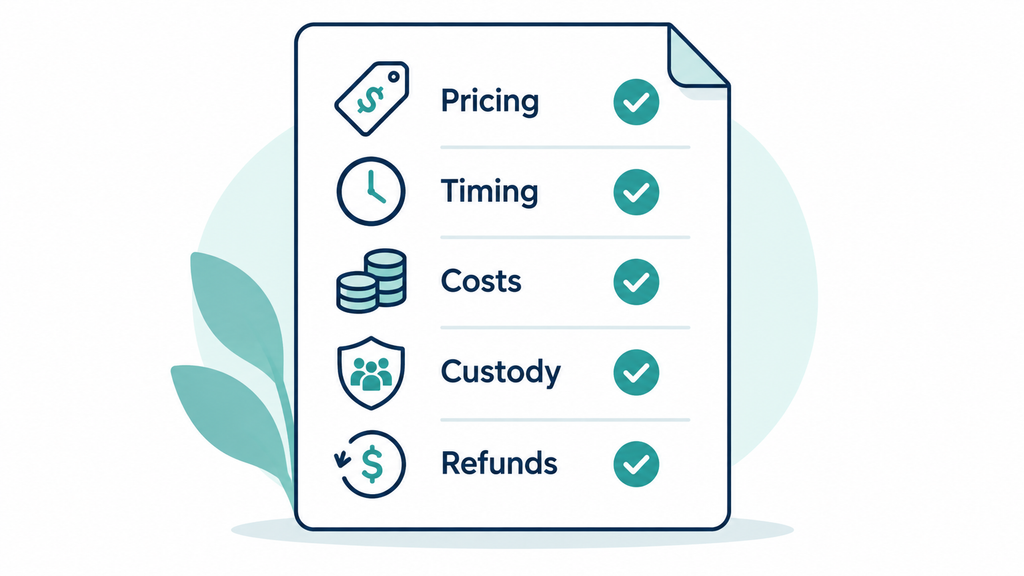
Use the following as a drafting checklist, not a substitute for an engagement agreement tailored to the applicable rules. Each answer should describe an actual process the firm can follow.
- What is owed? State whether charges are calculated in dollars or token units.
- What asset is accepted? Specify the token and blockchain network.
- How is value established? Identify a pricing source, valuation time, and fallback if the source is unavailable.
- When is payment complete? Explain confirmation requirements and the treatment of late or partial transfers.
- Who pays transaction costs? Address network charges, processor fees, conversion costs, and withdrawal charges.
- What happens after receipt? State whether crypto will be held or converted, by whom, and under what authority.
- How are advances and refunds calculated? Explain earning milestones, withdrawals, and the method for returning the unearned balance.
- How are disagreements handled? Identify the accounting and dispute-resolution process.
One detail I would not overlook is a stale payment quote. Specify what happens if the client transfers after a quote expires, rather than deciding afterward who absorbs the difference.
Advance payments, client ownership, and refunds
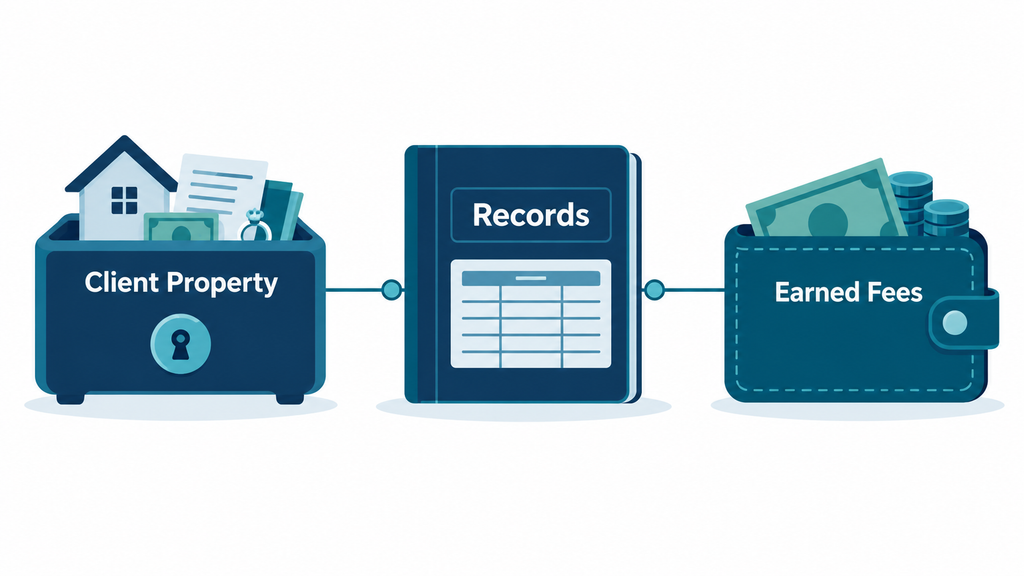
The current text of D.C. Rule 1.15 on safekeeping property makes unearned advances client property by default, unless the client gives informed consent to a different arrangement. Even with that consent, the unearned portion must be returned when the representation ends.
The rule also requires separating and appropriately safeguarding client property. A firm should not assume that labeling a wallet “trust” resolves the ownership, accounting, or custody requirements.
Why a refund formula matters
Suppose a client transfers 0.10 BTC as an advance, and the engagement ends after some work is completed. Without a clear agreement, “refund the balance” leaves unanswered whether the balance is measured in token units or dollars and which valuation time applies.
I recommend working through an early-termination example before signing. Ask the firm to demonstrate the calculation using its proposed terms, including transaction costs and any conversion already authorized.
Keep ownership records separate from access credentials
A useful operational record connects the client, matter, transaction, and accounting entry. For each receipt or withdrawal, record the asset, network, amount, date, transaction identifier, valuation evidence, and purpose.
Ownership documentation and technical access also matter in estate planning, as explained in how to put crypto in a trust. An estate-planning trust is a different legal arrangement from a lawyer’s client-property account, but both require coordinating documents and access.
Secure custody needs a workable access plan
D.C. Rule 1.1 on competence requires the knowledge, preparation, and skill reasonably necessary for the representation. For cryptocurrency custody, I recommend treating access management as a professional workflow rather than leaving it to whoever first created the wallet.
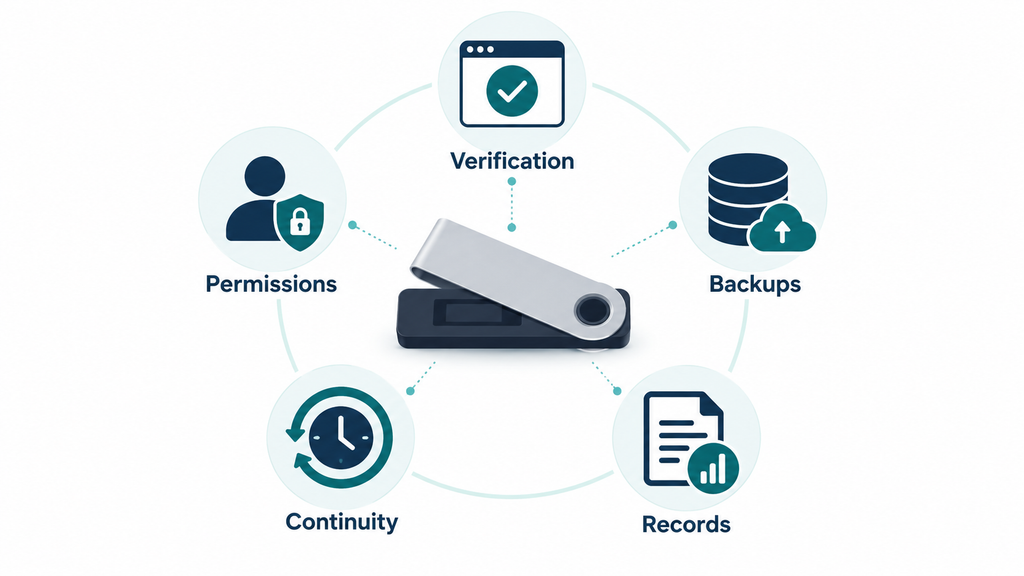
The following are practical controls to evaluate with a qualified security specialist. They are recommendations, not a claim that one wallet design guarantees ethical compliance.
- Use a documented method to separate client assets from firm holdings.
- Verify receiving addresses and blockchain networks through a trusted channel.
- Limit signing authority and document who can approve transfers.
- Protect recovery material from both theft and accidental destruction.
- Plan for authorized access if the responsible lawyer becomes unavailable.
- Reconcile wallet activity against matter records regularly.
Ask about failure scenarios
Before choosing a custody provider, ask what happens if withdrawals are frozen, an employee leaves, or a signing device stops working. Request clear answers about asset control, recovery procedures, and any insurance exclusions rather than relying on a security badge.
If a transfer goes missing, preserve the transaction identifier and contact the relevant provider through a verified channel. Pointed Editorial’s guide to finding a legitimate crypto recovery provider explains how to evaluate recovery claims and avoid paying for unrealistic promises.
Price changes and taxes are separate questions
The fairness analysis should not be confused with hindsight about investment performance. D.C. Ethics Opinion 300 on property-based fees, which informs Opinion 378, evaluates reasonableness at the time of the arrangement rather than treating subsequent appreciation alone as proof of an unethical fee.
That principle does not permit ignoring custody, accounting, or refund obligations. I recommend documenting the original valuation and risk allocation so later discussions can focus on the agreed facts.
Paying with crypto can create a tax event
The IRS guidance on digital assets treats digital assets as property and addresses both payments for services and dispositions of assets. A client paying a legal bill with investment cryptocurrency may realize a capital gain or loss, while a firm receiving crypto as compensation generally has business-income reporting considerations.
For example, assume tokens with a $1,200 tax basis are used to settle a $2,000 bill. The simplified difference is an $800 gain before considering applicable adjustments; paying the bill does not erase that separate tax question.
Keep transaction dates, units, dollar values, and basis records available for your tax adviser. Ask specifically about advance deposits, because client property held in custody should not casually be recorded as already-earned revenue.

Check jurisdiction before adopting a crypto payment policy
Opinion 378 addresses the D.C. ethics framework, so do not assume its approach controls every engagement. Published guidance elsewhere illustrates why checking local requirements is essential.
Virginia Legal Ethics Opinion 1898, approved in September 2022, permits cryptocurrency advances subject to safeguards and does not require conversion into dollars. In contrast, North Carolina’s 2019 Formal Ethics Opinion 5 permits certain flat-fee arrangements but prohibits receiving cryptocurrency as entrusted property under its analysis.
Those opinions are jurisdiction-specific guidance, not interchangeable templates. For a multijurisdictional practice, I would obtain an ethics review of the proposed workflow before offering it across the firm.
Frequently asked questions
Where can I find the official D.C. Bar Ethics Opinion 378 cryptocurrency text?
Use the D.C. Bar’s official Opinion 378 page linked near the beginning of this guide. Read it alongside the applicable rules, because a summary cannot resolve every fee arrangement or subsequent legal development.
Does DC Bar Ethics Opinion 378 allow cryptocurrency legal fees?
Yes, subject to the applicable ethical requirements. The practical starting point is to identify whether the payment covers earned fees, future work, or an obligation priced in cryptocurrency.
Can a client be required to make payment of legal fees in cryptocurrency?
Opinion 378 contemplates arrangements that accept or require cryptocurrency, but that does not make every proposed arrangement acceptable. Before agreeing, ask why crypto is required and how valuation, custody, and refunds will work.
Must a lawyer immediately convert cryptocurrency into dollars?
Opinion 378 does not impose a blanket requirement to convert immediately. The agreed arrangement and applicable jurisdiction matter, so the client should receive a clear explanation of whether the firm will hold or sell the assets.
Does a signed agreement make any cryptocurrency fee acceptable?
No, client consent does not replace the requirement for a reasonable fee or fair terms where Rule 1.8(a) applies. A signature should document informed agreement, not conceal an unexplained financial risk.
Conclusion: Agree on the mechanics before sending crypto
The practical lesson of D.C. bar ethics opinion 378 cryptocurrency guidance is to define the arrangement before the transfer. You should be able to explain the price, valuation method, ownership, security process, and refund calculation without guessing.
Before paying or accepting a crypto legal fee, use the agreement checklist above to identify unanswered questions. Ask qualified ethics counsel to review the proposed terms and workflow, then complete the transfer only after both sides understand what they are agreeing to.